
Springleaf Residence: Condos from S$860k
Thirty-two of Springleaf's 941 homes sit in a conserved school block, a different product, a different resale market, one shared maintenance budget.
By Invest Singapore Editorial · Updated August 27, 2026 · 9 min read
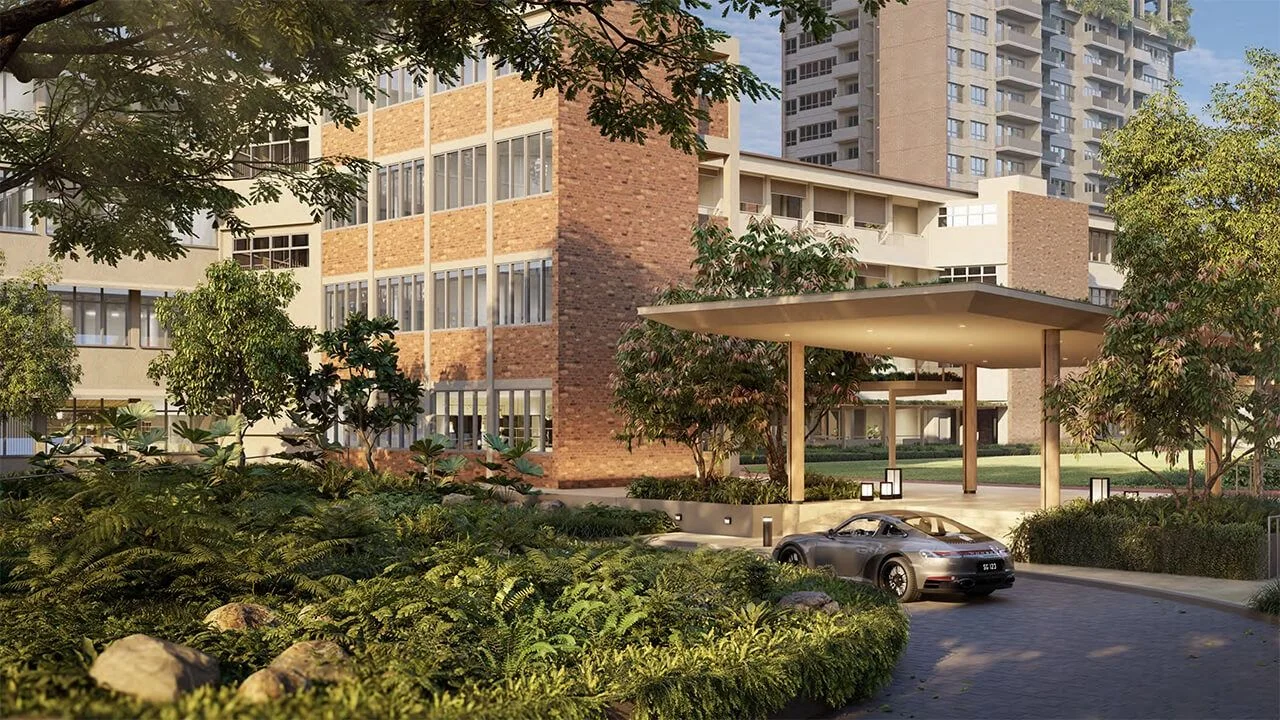
Quick answer: Springleaf Residence is 941 homes by GuocoLand and Hong Leong Holdings, launched around S$2,175 psf and about 92% sold. Nine hundred and nine of them are in five new 25-storey towers. The other 32 are inside a conserved block that used to be Upper Thomson Secondary School, and they are a different asset sharing one management corporation with the rest.
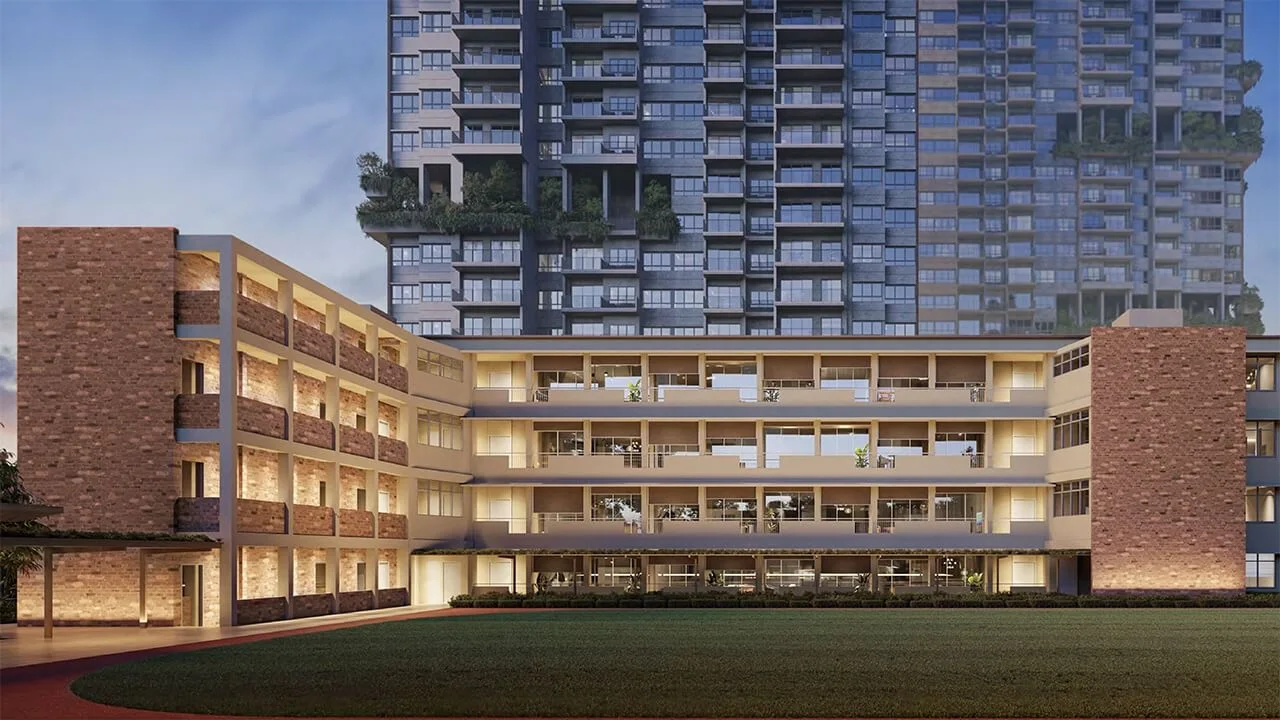
Two products, one strata title
The masterplan places five 25-storey towers alongside a retained four-storey block, the former Upper Thomson Secondary School. The towers hold 909 apartments; the conserved building holds 32.
| The five towers | The conserved block | |
|---|---|---|
| Units | 909 | 32 |
| Building | New-build, 25 storeys | Retained four-storey school |
| Layouts | Standard modern condominium | Constrained by existing structure |
| External alterations | Ordinary | Restricted by conservation conditions |
| Repair and material choices | Ordinary | Conservation-compliant, usually costlier |
None of that makes the conserved units better or worse. It makes them different, and difference inside a single strata development is where the interesting questions live, because the two groups of owners share a budget, a committee and a set of by-laws.
Who pays for the old building
Conservation is an obligation on the fabric, not a preference. Where a building is conserved, what may be changed externally is limited, and repairs frequently require specific materials or methods rather than the cheapest available. That raises the lifetime cost of maintaining that structure relative to a new tower of equivalent floor area.
The cost lands in the management corporation’s budget, which every owner funds according to their share value. So the practical question for a buyer in the towers is how much of their monthly contribution maintains a building they will never enter, and for a buyer in the conserved block it is whether their share value reflects the extra burden they bring or the scarcity they enjoy.
Both answers are in the strata schedule and the projected budget, and both are available before purchase. This is the single document set worth reading closely here, and it is the one that never appears in a showflat.
Share value is the mechanism
The word that decides all of this is not conservation. It is share value, and it appears in the strata schedule rather than in any brochure.
Every unit in a strata development is allotted a share value. It does two jobs at once. It sets the proportion of the management corporation’s budget that unit contributes each month, and it sets the weight of that unit’s vote in the decisions the corporation takes.
Both jobs matter here, and they pull in opposite directions for the 32 owners in the conserved block.
On contributions, the question is whether the schedule recognises that the building they live in costs more to maintain than an equivalent floor area of new tower. If it does not, the towers subsidise them. If it does, they pay a premium for the privilege of the address inside their own address.
On votes, the arithmetic is blunt and does not change over the life of the development. Thirty-two units against 909 is a permanent minority in every general meeting. Decisions about how much to spend on the conserved fabric, when to schedule works on it, and how to allocate the sinking fund between the old building and the new towers will be taken by an electorate that overwhelmingly does not live in it.
That is not an accusation of bad faith; management corporations generally behave reasonably, and conservation obligations are legal duties rather than discretionary spending. But a buyer in the conserved block should understand that their building’s upkeep is funded and directed by their neighbours, and a buyer in the towers should understand what share of their contribution is committed to a structure they cannot enter.
The schedule of share values and the first year’s projected budget answer both questions in about ten minutes, and they are the two documents this development most rewards reading.
The resale split
Adaptive reuse produces homes that cannot be reproduced. Volumes, window rhythms and floor plates inherited from a 1960s or 1970s school building are not available in any new tower, and buyers who want that specifically have almost nowhere else to look.
That produces a narrow, intense demand: few buyers, but the ones who exist are motivated and often willing to pay a premium for the character. The counterpart is that 32 units transact very rarely, so price discovery is lumpy and a seller may wait.
The towers behave conventionally by comparison. Nine hundred and nine units generate steady transaction volume, comparables are easy to find within the development itself, and a seller competes with neighbours rather than waiting for a specialist buyer.
A buyer should decide which market they want to be in before choosing a stack, because the two behave differently at exit and the difference persists for the life of the lease.
One further point about the split is easy to miss at a showflat, because showflats present a single product. Prospective buyers are shown a development, but they are choosing between two of them, and the choice is effectively irreversible: there is no internal market between the block and the towers, and a household that decides after two years that it wanted the other one has to sell and buy again, paying the full duty on the second purchase.
First high-rise in a low-rise estate
Springleaf historically leaned landed and low-rise, and this is the first high-rise private residential project there. That has consequences beyond the view.
The development is not entering an established condominium market; it is establishing one. There are no neighbouring high-rise comparables of similar vintage to price against, so for several years the most relevant evidence for any resale here will be other transactions inside Springleaf Residence itself. Valuers will reach outward to the Lentor cluster and the wider D26 market, which are different products in different settings.
The upside of being first is that a well-received development sets the reference rather than following one. The risk is that the estate’s character changes around it in ways nobody can price yet, and that the first sellers do so into a market with thin evidence.
| Reference | psf (S$) |
|---|---|
| Springleaf Residence launch average | 2,100 - 2,250, about 2,175 at launch |
| D26 Lentor cluster new launches, 2025 | 2,050 - 2,400 |
| Ticket | From (S$) | To (S$) |
|---|---|---|
| 941 units, 99-year leasehold | 860,000 | 3,490,000 |
Ninety-two percent sold
At that level the primary market is nearly closed, and what remains is likely to be the units earlier buyers passed over. In a development with two distinct products that is worth parsing carefully: residual stock in the towers is an ordinary late-stage choice, while any remaining conserved-block unit is unusual enough that its availability deserves a direct question about why.
For an overseas purchaser the duty is unaffected by which product they choose: additional buyer’s stamp duty at the 60% foreign tier applies to the transacted price either way, which on the S$860,000 floor is S$516,000 and at S$3,490,000 is S$2,094,000, before buyer’s stamp duty. The ABSD guide has the tiers and the remission order the five treaty nationalities.
Upper Thomson Parcel A sits on the same road and its story is a failed tender rather than a conserved building; Artisan 8 is the other project in this pipeline with two classes of owner inside one management corporation. Regional context is in the CCR, RCR and OCR guide and early-exit costs in the seller’s stamp duty ladder. What settles this particular purchase, though, is a strata schedule and a projected budget, and a buyer has to ask for both by name.
Frequently Asked Questions
They sit inside a conserved four-storey block that once housed Upper Thomson Secondary School, rather than in the five new 25-storey towers beside them. That makes them a different product on the same title: different floor plates, different ceiling heights, different outlook, and a conservation obligation attached to the fabric that the towers do not carry.
It can, and the liability is shared. Conservation status constrains what may be altered externally and often what materials may be used in repair, which raises the cost of works on that part of the estate. Those costs sit in the same management corporation budget as the towers, so all 941 households contribute to maintaining a building only 32 of them live in.
For the right buyer, clearly. Adaptive reuse of a school building produces layouts and volumes that a new tower cannot replicate, and there are only 32 of them in Singapore's newest private estate in Springleaf. For everyone else it is a smaller, older-fabric home in a development whose other 909 units are new-build, and the resale pool reflects that split.
The launch averaged around S$2,175 psf with a guide band of about S$2,100 to S$2,250, and the development was roughly 92% sold. Entry across the range runs from about S$860,000 to S$3,490,000 for 941 units by GuocoLand and Hong Leong Holdings on a 99-year leasehold title.
Because this is the first high-rise private residential project in Springleaf, an area that historically leaned landed and low-rise. The development is not joining an existing condominium market; it is creating one, which means its own resale transactions will be the primary evidence for years.
The conservation conditions attached to the block, the maintenance and sinking fund allocation between the conserved building and the towers, and the share values in the strata schedule. Those three documents determine whether the 32 owners are subsidising the estate or being subsidised by it.
Get your Singapore property shortlist
Share your budget and target region. We respond within one business day.