
Upper Thomson Parcel A: Condos from S$1.65m
The same Springleaf site failed in 2024 and drew five bids in 2025. Only one thing changed: URA dropped the mandatory long-stay serviced apartments.
By Invest Singapore Editorial · Updated August 27, 2026 · 9 min read
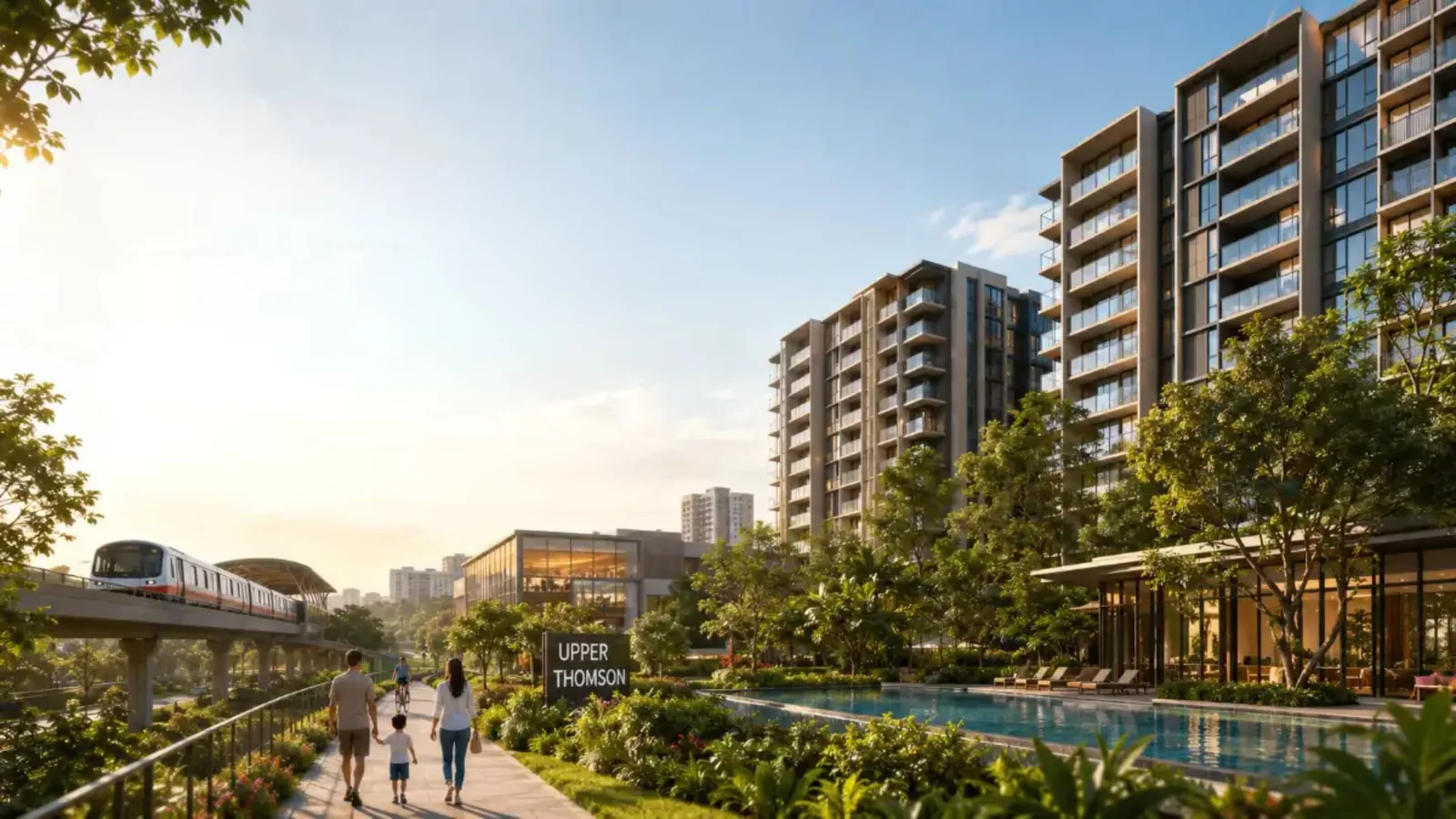
Quick answer: Upper Thomson Road Parcel A is about 595 units by Wee Hur Property and GSC Holdings, in two 25-storey towers beside Springleaf MRT with ground-floor retail, from roughly S$1,650,000 at S$2,200 to S$2,300 psf. The site was tendered twice. The first attempt, in 2024, carried a mandatory long-stay serviced apartment component and failed. URA removed it, and the second attempt drew five bids at S$613.9 million.
One parcel, offered twice
| 2024 tender | October 2025 tender | |
|---|---|---|
| Site | 2.44 ha, Upper Thomson Road | Unchanged |
| Serviced apartment requirement | Mandatory long-stay component | Removed |
| Bids received | No acceptable bid | Five |
| Outcome | Tender failed | S$613.9m, S$1,062 psf ppr |
| Winner | , | Wee Hur Property, GSC Holdings |
Land is not usually re-run as an experiment. Sites are offered once, conditions and all, and if the result disappoints the parcel goes back into the reserve list and re-emerges years later into a different market. Here the interval was short enough and the change specific enough that the two results are comparable.
What the condition was asking for
A mandatory long-stay serviced apartment component is not a marginal design note. It requires the developer to build, retain and operate a category of accommodation with an entirely different economic shape from the apartments it would otherwise sell.
Selling apartments converts a site into cash over a defined sales period. Operating long-stay accommodation means holding the asset, staffing it, filling it against corporate and relocation demand, and carrying its vacancy. The skills are different, the balance sheet treatment is different, and at Springleaf, away from the business districts that generate that demand, the tenant pool was unproven.
Faced with that, residential developers did what the arithmetic told them to do. They did not bid.
Reading the second result
Five bids is not merely more than none; it is a competitive field, which means the parcel was attractive on its own merits the moment the obligation came off. The winning rate of S$1,062 per square foot per plot ratio then does two jobs for a buyer.
It sets the floor under the price list. A developer paying that rate, before construction, finance, marketing and margin, cannot guide far below the S$2,200 to S$2,300 psf that analysts have projected. The number is not a marketing position; it is arithmetic that was fixed in October 2025.
And it dates the lease. The 99 years begin from that award, which matters more than it sounds at a horizon where the comparison set includes D20 resale stock already a decade or two into its own clock.
What lifted rules do next
A condition that was withdrawn can be reinstated, and the withdrawal applied to a tender, not to the neighbourhood in perpetuity. Nothing about that threatens this development: the site is awarded, the lease is issued, the scheme is fixed.
It matters for the comparison set instead. If long-stay requirements return to later parcels along this corridor, subsequent launches will carry a cost this one does not, and the relative position of a 2026 buyer improves. If the relaxation continues, the corridor’s future supply arrives on the same terms and competes directly. A buyer choosing between this and the other Thomson-corridor launch is, without necessarily realising it, taking a small position on which of those happens.
The retail at the foot of the towers
Roughly 2,000 square metres of commercial space sits at street level, and the honest account of it is stack-specific rather than project-wide.
Convenience retail directly downstairs is a genuine amenity, particularly at the northern end of the line where the alternative is a drive. It also generates the ordinary consequences of a commercial tenancy: servicing in the early morning, kitchen extraction if food and beverage is permitted, refuse collection, and activity in the evening under whichever residential floors sit above it.
The documents that settle this are the strata plan, which shows what is above what, and the by-laws and permitted-use schedule, which govern what those tenancies may become after the first operators leave. Both are available before booking, and neither appears in a brochure.
Springleaf itself
The station is on the doorstep rather than a walk away, on the Thomson-East Coast Line. Lower Seletar Reservoir parkland is close, and the Upper Thomson dining belt runs south from there and does much of the corridor’s reputational work.
This is the quieter end of D20 and it has historically leaned low-rise. Two 25-storey towers with 595 homes and a retail podium is a change of kind for the immediate pocket, not just an addition to it, the same shift already underway a short distance away at Springleaf Residence.
What the award arithmetic implies about unit sizes
The published figures constrain the product more tightly than the marketing does, and the working is short enough to do by hand.
S$613.9 million at S$1,062 per square foot per plot ratio implies gross floor area of roughly 578,000 square feet. The site is 2.44 hectares, about 262,600 square feet, so the parcel is being built at a plot ratio of a little over 2.2. Take out the roughly 2,000 square metres of commercial space at street level and about 556,000 square feet of gross residential area remains, spread across some 595 apartments.
That is an average of around 935 gross square feet per home, and gross floor area includes the corridors, lift lobbies, stairs and service risers apportioned to each unit. Saleable areas will be meaningfully smaller than that average, and the mix will lean towards one- and two-bedroom layouts to reach the unit count.
None of this is a criticism; it is the shape the plot ratio dictates, and it is the same shape most recent Outside Central and city-fringe launches have taken. It is worth doing before a showflat visit for one reason. A buyer who has decided they need three bedrooms and a study will be shopping in the thinnest part of this release, competing with the same handful of layouts everyone else has identified, and the price list will reflect that scarcity rather than any generosity in the average.
Sizing the ticket
| Bedroom type | Typical size (sq ft) | Guide psf (S$) | From (S$) |
|---|---|---|---|
| 2-bedroom | 750 | 2,200 - 2,350 | 1,650,000 |
| 3-bedroom | 950 | 2,200 - 2,450 | 2,090,000 |
| 4-bedroom | 1,150 | 2,300 - 2,550 | 2,645,000 |
| Reference | psf (S$) |
|---|---|
| Land rate paid, October 2025 | 1,062 per plot ratio |
| Analyst guidance for the launch | 2,200 - 2,300 |
| D20 resale condominiums, 2025-26 | 1,850 - 2,280 |
An overseas purchaser should add the duty to those figures before treating them as a budget: additional buyer’s stamp duty at the 60% foreign tier is S$990,000 on the S$1,650,000 entry, payable in cash within 14 days of exercising the option and outside the mortgage. The ABSD guide sets out the tiers and the remission order the five treaty nationalities that are assessed as citizens.
The two dates a buyer should write down
October 2025, when the lease began and the land cost was fixed, and the 2030-to-2031 completion window, when the towers and the roughly 500 units on the former Thomson View site reach the market together.
Everything between those dates is progress payments against a scheme that already has a price floor and a delivery obligation. Everything after them is a corridor absorbing eleven hundred new homes at once. The seller’s stamp duty ladder explains why a buyer who has not planned past the second date should not be committing at the first.
Frequently Asked Questions
The 2024 tender required a mandatory long-stay serviced apartment component on the site. That obligation carried an operating model most residential developers do not run, a slower and less certain income profile than selling apartments, and no established resale market at that location. The tender closed without an acceptable bid.
URA removed the mandatory serviced apartment requirement. Nothing about the land itself changed: same 2.44-hectare parcel, same Springleaf frontage, same station beside it. The site was re-offered and drew five bids, with Wee Hur Property and GSC Holdings paying S$613.9 million, or S$1,062 per square foot per plot ratio, in October 2025.
It puts a price on a planning condition. Between the two tenders the only material variable was the requirement, so the difference between no acceptable bid and five competitive ones is close to a clean measurement of what that one obligation cost. Very few conditions in Singapore planning are ever isolated that cleanly.
About 595 apartments in two 25-storey towers, with roughly 2,000 square metres of commercial space at street level, on a fresh 99-year lease from the October 2025 award. Completion is indicated around 2030 to 2031, with the launch expected in the 2026 pipeline.
It cuts both ways and the split is by stack, not by project. Street-level commercial supplies convenience that a purely residential block does not have, and it also produces deliveries, extraction, refuse cycles and evening activity directly under the lowest residential floors. The mitigation is in the layout: which stacks sit above which tenancies, and what the by-laws permit those tenancies to be.
About S$1,650,000 to S$2,600,000 across the 595 units, on analyst guidance of roughly S$2,200 to S$2,300 psf against the S$1,062 psf per plot ratio land rate. The authorised price list issued on booking day is the binding document, and effective psf within a single bedroom type commonly varies 8 to 15 percent by stack, floor and facing.
Get your Singapore property shortlist
Share your budget and target region. We respond within one business day.