
Dorset Road GLS Review 2026: From S$1.90m, 428 Units
Dorset Road's breakeven sits above S$2,700 psf and the guide starts at S$2,700. An honest price and a seller with no room to discount.
By Invest Singapore Editorial · Updated August 27, 2026 · 9 min read
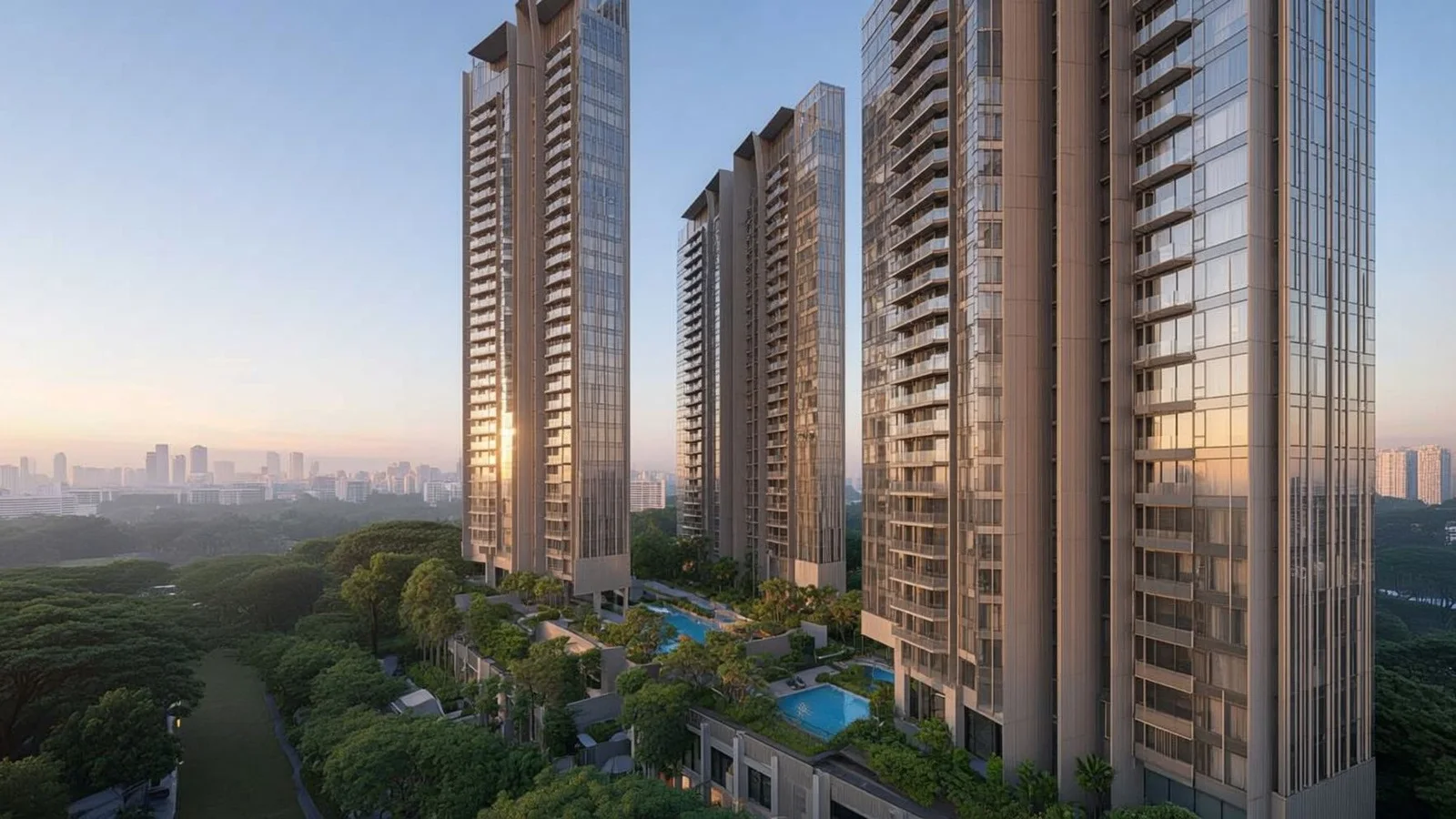
Quick answer: Dorset Road is 428 units in two 27-storey towers at Farrer Park, by a UOL, Singapore Land and Kheng Leong consortium, guiding S$2,700 to S$3,200 psf. The number that explains the page is S$1,338 per square foot per plot ratio, paid in October 2025: after construction and finance, breakeven sits above S$2,700, and the guide starts there.
Where the price comes from
Most launch pricing is opaque, because the developer’s cost base is private. Here it is not. The land was bought at public tender, the result was published, and the arithmetic between that number and the price list is short enough to follow.
| Component | What is known |
|---|---|
| Land consideration | S$524.3 million |
| Land rate | S$1,338 psf per plot ratio |
| Units | 428, in two 27-storey towers |
| Launch guide | S$2,700 - S$3,200 psf |
| D12 resale, 2025-26 | S$2,340 - S$2,880 psf |
A land rate of S$1,338 psf ppr is roughly half the launch floor before a single wall is built. What sits between them is construction on a two-tower scheme, financing across four years, marketing, professional fees and the consortium’s return. On any conventional assumption those consume most of the gap, which is how breakeven arrives above S$2,700.
What a tight breakeven means for a buyer
This is the unusual part and it deserves to be read carefully, because it cuts in two directions at once.
In the buyer’s favour: the price is not padded. On projects where the land was cheap or acquired long ago, a launch price can carry a large margin that the buyer funds and never sees. Here that is not available. Whatever else is true of this launch, a purchaser is not paying for a comfortable developer position.
Against the buyer: there is no shock absorber. A developer with margin can respond to a slow launch by discounting, offering furnishing packages or repricing later releases. A developer at breakeven cannot do any of that meaningfully, because every concession comes out of the return rather than out of the fat. The realistic responses to a soft market here are to hold stock, to slow releases, and to wait.
For an early buyer that second point matters more than it first appears. It reduces the risk of watching later buyers pay less, which is a common and demoralising experience at large launches. It also means that if demand disappoints, the project’s unsold inventory persists into completion rather than clearing at a discount, and persistent developer stock is a competitor at resale, as buyers elsewhere in this pipeline discover.
What the breakeven claim is, and is not
The figure above is an inference, and it should be labelled as one before anything is built on it.
What is documented is the land: S$524.3 million, S$1,338 psf per plot ratio, awarded in October 2025. What is not documented is everything after it. Construction cost on a two-tower residential scheme, the cost of financing that construction across roughly four years, professional fees, the marketing budget and the consortium’s required return are all private, and each is a range rather than a number.
Run those ranges at conventional values and breakeven lands above S$2,700 psf, which is why the coincidence with the guide floor is worth noticing. Run them at the optimistic end: a keen main contractor, a fast sell-through that shortens the finance period, a modest return target, and the figure drops. Run them at the pessimistic end and it rises past the middle of the guide band.
So the honest statement is narrower than it first sounds: on ordinary assumptions the room between land cost and asking price is thin, and there is no plausible set of assumptions under which it is generous. That is enough to support the conclusions on this page, and it is not enough to support a claim about the consortium’s exact margin, which nobody outside it can compute.
Two things would change the picture and both are observable. A construction contract awarded well below expectation would widen the gap, and it will eventually show up in the pace of works. A launch that stalls would narrow it, because carrying cost accrues whether or not units sell, which is the mechanism by which a slow start makes a discount less likely rather than more.
One consequence follows immediately and is worth holding on to through any showflat conversation. Where the gap between cost and price is thin, the developer’s flexibility is not in the price but in the timing, so the concessions on offer will be about when a buyer pays rather than how much.
The city-fringe premium has to hold
Everything above rests on the location argument continuing to work. Farrer Park sits at the fringe of the central area: close enough for a short commute, outside the core, and served by rail. The launch guide asks the market to accept city-fringe pricing on a Rest of Central Region address, and the resale band of S$2,340 to S$2,880 shows the market has been paying something close to that for existing stock.
The exposure is that the premium is doing a lot of work in a project with no margin. If city-fringe demand softens, through rates, through supply, through a shift in where people want to live: the developer cannot absorb it, and the adjustment appears in transaction volume rather than in price.
A buyer’s protection against that is holding period rather than negotiation. A purchase that works over ten years is insulated from a two-year soft patch; one that depends on selling into the first resale window is not.
Two towers, 428 units, one completion
Scale here is moderate by launch standards and the format is conventional: two 27-storey towers, a single completion, one management corporation. That is worth noting mostly because it is unremarkable, which is not true of several other projects in this pipeline.
What it means in practice is that the risks on this page are financial rather than structural. There is no precinct to wait for, no infrastructure obligation, no eligibility gate and no mixed-use governance question. The building will be built, in a location that already functions, by a consortium whose lead partner is one of Singapore’s established listed developers. The open question is only whether the price is right, and the land rate gives an unusually direct way to think about it.
What to ask before booking
Three questions, all of which have documented answers:
- What proportion has been released, and at what prices? In a breakeven-constrained project, release pacing is the developer’s main lever and it tells you how the launch is going.
- What is the completion programme? Two towers can be phased; a buyer in the later phase waits longer and completes into a different market.
- Which stacks face what? With a tight price band across the project, the variation between units matters proportionally more than usual.
For a foreign buyer the duty reframes all of it: at the 60% tier, additional buyer’s stamp duty on the S$1,900,000 floor is S$1,140,000 before buyer’s stamp duty, which is close to the entire land cost per unit. The ladder is in the ABSD guide, the treaty exceptions in the remission order.
River Valley Green is the other contested-tender parcel in this pipeline, and its arithmetic runs the opposite way: a higher land rate producing a lower guide. Regional definitions are in the CCR, RCR and OCR guide and the four-year exit schedule in the seller’s stamp duty ladder. Read the two parcels side by side and the general lesson emerges: a published land rate never tells a buyer what the price will be, but it does tell them which prices are impossible.
Frequently Asked Questions
Because the land cost most of the price. URA awarded the site at S$524.3 million, or S$1,338 per square foot per plot ratio, in October 2025. Once construction, financing and marketing are added, the developer's breakeven sits above S$2,700 psf, and the launch guide starts at S$2,700. A consortium in that position cannot cut price without selling below cost.
Both, and it is worth separating them. It means the asking price is not padded, which is reassuring on value. It also means there is no cushion: if the market softens between launch and completion, the developer cannot respond by discounting, so unsold stock is more likely to be held than repriced. The buyer gets an honest price and an inflexible seller.
United Venture Development (2022) Pte. Ltd., a consortium of UOL Group at 60%, Singapore Land Group at 20% and Kheng Leong Company at 20%, delivering 428 residential units across two 27-storey towers on a 99-year leasehold title in the Farrer Park area.
Entry from about S$1,900,000 to S$2,900,000 on a launch guide of S$2,700 to S$3,200 psf, against a D12 resale band of S$2,340 to S$2,880 for 2025 and 2026.
It was the Confirmed List site at the city fringe in that round, which concentrated bidder attention. A contested tender for a well-located parcel produces exactly the land rate seen here, and that rate then constrains everything downstream, including how the project can be marketed.
That the price list is close to the developer's floor, so negotiation is unlikely to yield much and the risk of a later discount to earlier buyers is correspondingly low. It also means the project needs the city-fringe premium to hold: there is no margin to absorb a softer market.
Get your Singapore property shortlist
Share your budget and target region. We respond within one business day.