
GATE+ Jurong Review 2026: From S$792k, 265 Units
GATE+ is B2 industrial on a 33-year lease: no residential ABSD, no en-bloc endgame, and an exit year that has to be chosen at purchase.
By Invest Singapore Editorial · Updated August 27, 2026 · 11 min read
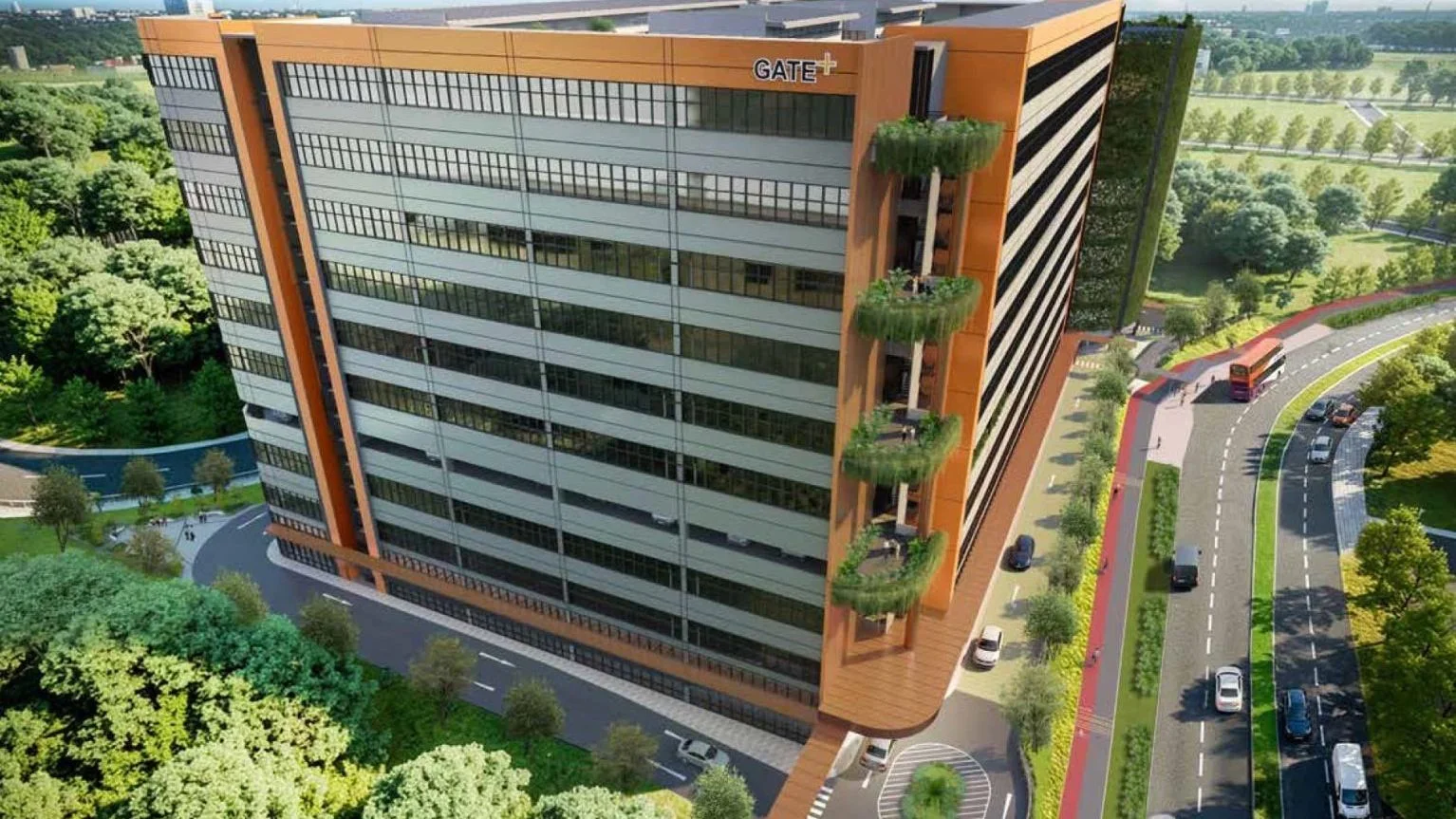
Quick answer: GATE+ Jurong is 265 B2 industrial strata units on Tukang Innovation Drive, on a 33-year lease, averaging around S$660 to S$720 psf from about S$792,000. It is the only non-residential asset in this pipeline, and almost every rule of thumb that applies to the rest of these pages is wrong here, starting with additional buyer’s stamp duty, which does not apply at all.
The duty rules are not the residential ones
The single most important thing to establish about this asset is what it is not. Additional buyer’s stamp duty is a residential instrument. It applies to residential property, at tiers set by the buyer’s profile and number of holdings, and it is the dominant cost in almost every other purchase described on this site.
B2 industrial strata sits outside it. Stamp duty on an industrial purchase follows industrial buyer’s stamp duty rules, and there is no foreign-buyer tier, no second-property tier and no entity tier of the residential kind. A foreign investor and a Singaporean investor face materially more similar entry costs here than they would on any condominium in this pipeline.
This has to be stated plainly because industrial pages are frequently produced from residential templates, and a residential ABSD calculation applied to a B2 unit describes a charge that does not exist. Anyone modelling this asset should discard the residential duty framework entirely and price the industrial one, with a conveyancer who works on industrial transactions rather than on homes.
Thirty-three years is a schedule, not a tenure
The second difference is the lease. Ninety-nine-year residential leases behave, for a buyer’s practical purposes, like long-dated assets: the decay is real but distant, and there is a collective-sale mechanism at the end that can crystallise value. Freehold, as elsewhere in this pipeline, removes the question altogether.
A 33-year industrial lease does neither. It is an amortising interest with a defined end, no expectation of renewal on which an investment case can be built, and no en-bloc endgame. The value of the asset declines toward zero across the term, and the rate of that decline accelerates as the tail shortens and financing becomes harder to obtain.
The consequence is that an exit year is part of the purchase decision rather than a later choice. An investor buying at year zero with a fifteen-year horizon is selling an eighteen-year lease into a market that will price it accordingly. One who intends to hold for twenty-five years should be modelling the income to substantially cover the capital, because what remains at the end will be worth little.
Two taxes that do not appear on a residential page
Beyond the absence of the residential duty tiers, industrial ownership carries two charges that a buyer arriving from the condominium market will not have budgeted for.
The first is goods and services tax. Residential property sales are exempt from it, as the GST guide explains. Non-residential property sales are not, so where the seller is GST-registered the transaction attracts GST at 9% on top of the price. For a GST-registered buyer that is usually recoverable as input tax and becomes a cash-flow item rather than a cost; for a buyer who is not registered, it is simply 9% added to the entry price, which on the S$792,000 floor is a further S$71,280.
The second is property tax. Residential property is taxed on progressive schedules that differ for owner-occupiers and landlords. Non-residential property is taxed at a flat 10% of annual value, every year, with no owner-occupier concession available because there is no owner-occupier in the residential sense.
Both belong in the yield calculation from the outset. A gross rent per square foot per month that looks strong against a condominium becomes a different number once an unrecoverable 9% has been paid at entry and 10% of annual value is paid every year thereafter.
How industrial income actually behaves
Industrial yields look attractive next to residential ones and the reason is not generosity. It is that the risk is differently shaped.
| Variable | Residential condominium | B2 industrial strata |
|---|---|---|
| Typical lease length | 1-2 years | Shorter, business-driven |
| What the occupier prizes | Location, finishes, schools | Loading, power, floor loading, access |
| Pool of suitable tenants | Wide | Narrow, use-specific |
| Void risk | Weeks | Potentially months |
| Fit-out | Landlord’s, modest | Often tenant-specific and costly to reverse |
The narrow tenant pool is the crux. A residential unit suits almost any household of the right size; a B2 unit suits the businesses whose operations fit its ramp access, ceiling height, power supply and floor loading. When such a tenant leaves, the replacement search is longer and the unit may need reconfiguration. Rent per square foot per month is therefore only half the underwriting; the other half is how many months of the year it is collected.
Where the west’s industrial demand comes from
Tukang Innovation Drive sits inside the Jurong Innovation District, and the distinction between that and the Jurong Lake District matters for anyone reading across from the residential pages in this pipeline. The Lake District is a commercial and mixed-use precinct being assembled around offices and public realm. The Innovation District is an industrial and advanced-manufacturing precinct, and its occupiers are engineering, technology and production businesses.
That means the demand driver for this asset is industrial activity in the west, not the residential population growth or the transport upgrades that support the condominium pages and the District 22 Jurong area guide. Rail improvements matter here mainly through workforce access rather than through address desirability, and the relevant leading indicators are manufacturing investment and business formation rather than housing supply.
An investor should be comfortable holding a view about that. It is a genuine economic thesis with real supporting activity, and it is a different thesis from anything else on this site.
What the pricing says
| Reference | psf (S$) |
|---|---|
| GATE+ launch average, April 2026 | 660 - 720 |
| West B2 strata resale, 2025-26 | 550 - 680 |
| Ticket | From (S$) | To (S$) |
|---|---|---|
| 265 units, 33-year leasehold | 792,000 | 1,860,000 |
The launch clears the top of the resale band, which is the ordinary new-build position, with the important qualification that the resale comparables include stock on varying lease tails. Comparing psf between a fresh 33-year lease and a unit with fifteen years left is not a like-for-like exercise, and a buyer should insist on lease-adjusted comparables rather than headline rates.
What to verify before committing
The checks here are physical and legal rather than aesthetic:
- Permitted use. B2 covers a defined range of industrial activity; confirm what may and may not be operated from the unit, and what approvals a tenant would need.
- Loading and access. Ramp-up access, lift capacity, floor loading and power provision determine which tenants can use the space at all.
- Financing terms. Industrial lending is typically shorter-tenor and lower loan-to-value than residential, and a 33-year lease shortens it further as the tail runs down.
- The service charge and the estate’s management. Industrial strata estates vary widely in how well common areas, security and loading are run, and it shows up in lettability.
The rest of this pipeline is residential and its rules do not carry across. For what that residential framework actually charges, and therefore what this asset sidesteps, see the ABSD guide; for the bands it uses, the CCR, RCR and OCR guide; and for the nearest residential comparison in this same district, where every duty and tenure assumption above is reversed, Lucerne Grand. A buyer who cannot yet name the year they intend to sell a 33-year lease is not ready to buy one.
Frequently Asked Questions
No. Additional buyer's stamp duty applies to residential property. GATE+ is B2 industrial strata, so stamp duty follows the industrial buyer's stamp duty rules instead, and there is no foreign-buyer tier, no second-property tier and no entity tier of the kind that dominates every residential purchase in Singapore. Any residential ABSD figure quoted against this asset is simply the wrong instrument.
It is an amortising asset, and that is the central difference from every other project here. A 33-year industrial lease has no lease-renewal expectation and no en-bloc endgame: the value declines toward zero across the term. An investor is buying a stream of rent over a defined life, so the exit year has to be chosen at purchase, not discovered later.
On rent per square foot per month, against tenant covenant and fit-out. Industrial leases are typically shorter than commercial ones, tenants are more sensitive to loading, power and floor loading than to finishes, and voids can be longer because the pool of suitable occupiers for any given unit is narrow. The yield looks higher than residential because the risk profile is different, not because it is free money.
Entry from about S$792,000 to S$1,860,000, with a launch average around S$660 to S$720 psf against a west B2 strata resale band of S$550 to S$680. There are 265 units, developed by a consortium of SLB Development, Boustead Projects, KSH Holdings and Ho Lee Group.
Tukang Innovation Drive, inside the Jurong Innovation District. That is an industrial precinct rather than the Jurong Lake District commercial one, and the distinction matters: the tenant base here is manufacturing, engineering and technology operations, not offices. The relevant demand driver is industrial occupier activity in the west, not residential population growth.
Anyone applying residential logic. A buyer expecting capital appreciation on a fresh 99-year lease, ABSD-driven scarcity or an en-bloc exit is looking at the wrong asset class. B2 strata suits investors who want yield from a shorter, amortising lease and who can underwrite an industrial tenant.
Get your Singapore property shortlist
Share your budget and target region. We respond within one business day.