
Rivelle Tampines EC Review 2026: From S$1.26m, 550 Units
Rivelle is sold by eligibility, not psf: only citizen households may apply, and the foreign-buyer duty figures on EC pages describe an impossible purchase.
By Invest Singapore Editorial · Updated August 27, 2026 · 9 min read
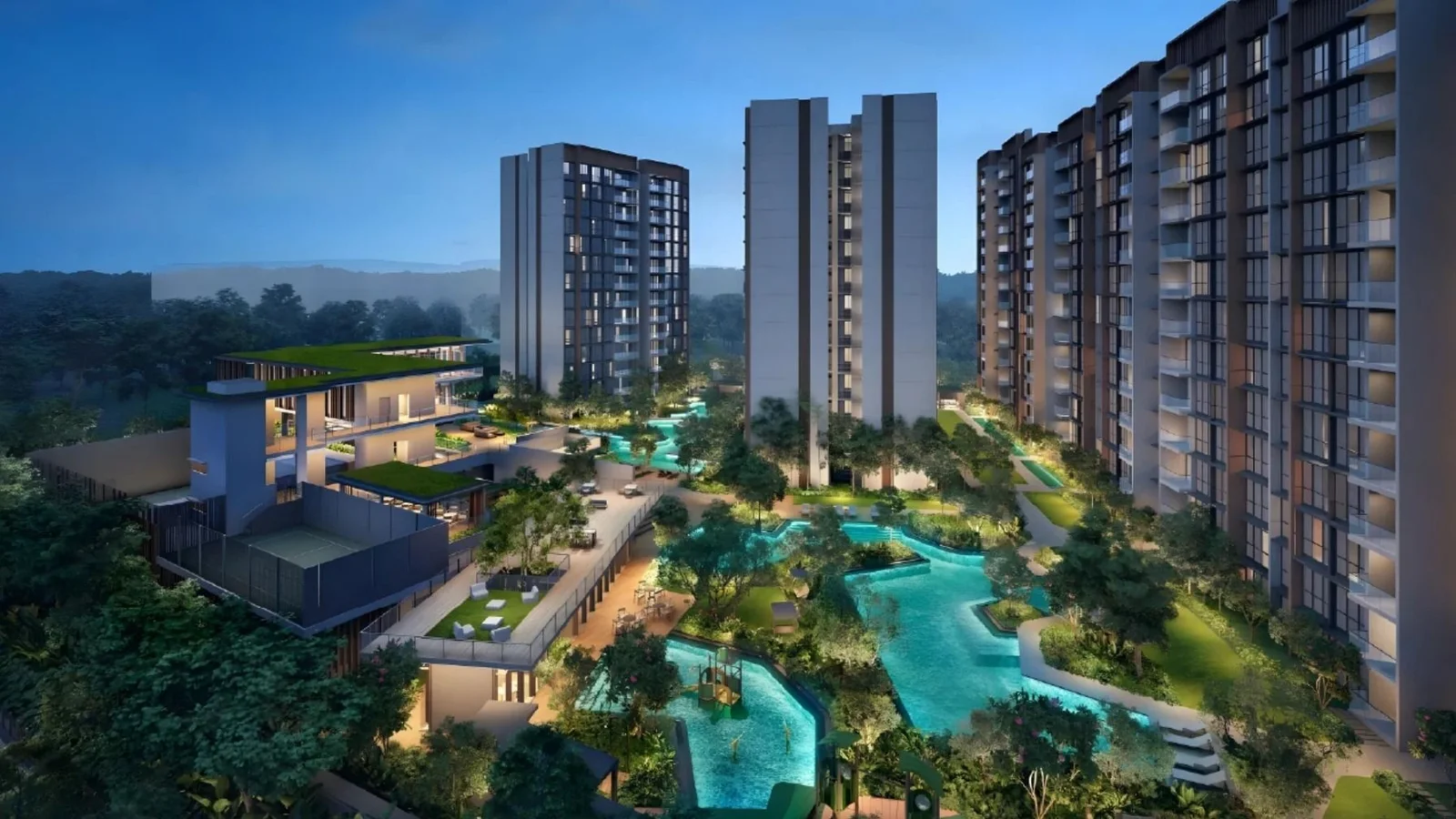
Quick answer: Rivelle is a 550-unit executive condominium in Tampines, from about S$1,260,000 at S$1,200 to S$1,400 psf, with a March 2026 launch window and completion around 2030. It is not sold on price. It is sold on eligibility: who is permitted to apply at all, and what the household has to prove to get through the door.
The gate, not the price list
Most of the pages in this pipeline turn on money: what the land cost, what the guide asks, how the two compare with resale. An executive condominium launch turns on something prior to that, which is whether a buyer is allowed to participate.
The eligibility conditions are set by public housing policy rather than by the developer:
- At least one applicant must be a Singapore citizen.
- The household must form a qualifying family nucleus under the prevailing rules.
- Household income must fall within the published ceiling.
- Restrictions apply around existing property ownership and previous housing benefits taken.
A household that satisfies all of these is competing for units at a price below comparable private stock. A household that fails any one of them is not in the market at all, regardless of what it can afford. That is a very different filter from the financial one that governs a private launch, and it explains why EC launches are discussed in terms of ballots and application windows rather than of price negotiation.
Why the foreign-buyer arithmetic does not apply
It is worth being explicit, because the error is common. Additional buyer’s stamp duty at the foreign tier is a charge on a transaction. At an EC launch, a foreign buyer cannot enter into that transaction: the eligibility rules exclude them entirely, so there is no purchase to tax.
A page that quotes a six-figure foreign duty against an EC entry price is therefore describing something that cannot occur. The realistic foreign route into this development is to buy from an owner after the tenth year, once the development is fully privatised, at whatever the market price is then and with the ordinary residential duty applying at that point.
For the household actually buying at launch, the relevant duty is buyer’s stamp duty on the purchase price, plus additional buyer’s stamp duty only if the household already holds residential property, which the eligibility rules substantially constrain in any case.
Two households, one price list, two entry costs
The gate does more than admit or exclude. It also sorts the households that get through into groups paying different amounts for the same unit, and the difference does not appear on the price list.
A household buying an executive condominium from a developer after having previously taken a housing subsidy: a flat bought directly from HDB, or a resale flat bought with a CPF housing grant, pays a resale levy. It is a charge for the second bite at public housing assistance, and it is settled on the new purchase. Two applicants can ballot for identical stacks, agree the same price with the same agent, and walk away with materially different totals, because one of them is repaying the benefit already received.
The second sorting mechanism is the existing flat. A household that owns an HDB flat may apply, but it must dispose of that flat within six months of the executive condominium reaching its occupation permit. That is a firm deadline attached to a date nobody controls, roughly four years out, and it lands in whatever market exists at the time. A household counting on a particular sale price to complete the sums is exposed to a market it will meet in about 2030, not to today’s.
Neither point is unusual and neither is hidden; both are set out in the prevailing rules. But they are the reason two applicants should not compare notes on affordability by comparing the price list. The list is the same for everyone who passes the gate. What it costs them is not.
The two dates that produce the return
Because the restrictions are the price discount, the value is realised when they lapse.
| Date from completion | What changes |
|---|---|
| Year 5 | The unit may be sold to Singapore citizens and permanent residents, and let as a whole |
| Year 10 | The development privatises; it may be sold to foreign buyers as well |
With completion indicated around 2030, those fall around 2035 and 2040. An owner who holds through both has bought at a policy-set discount and sells into a progressively wider market. An owner who needs to move earlier cannot, and the plan has no substitute.
This is the whole investment case and it is a patient one. It rewards households whose life plan matches the timetable, and it is unforgiving of those whose does not.
Waiting is the strategy, and it has a cost
Because the value is in the two thresholds, the obvious question is what the wait is worth against the alternatives, and the honest answer is that it depends on what the household would otherwise be doing.
Against continuing to rent, the comparison is straightforward: the household is paying down a loan on an asset at a policy-set discount instead of paying a landlord, and the restrictions cost it nothing it would have used.
Against buying private stock in the same town, the trade is sharper. A private purchase at a higher price can be let, or sold, at any point after the seller’s stamp duty period runs out. The executive condominium cannot be, and the discount is the compensation for that. A household with a stable plan through 2035 is being paid to give up an option it was never going to exercise. A household whose plan might change is selling a genuinely valuable option cheaply, and will find out which it was at the worst possible moment.
What Tampines brings to it
Tampines is a large, mature eastern town with deep amenity: retail, transport interchange, schools and employment within the region, mapped in the District 18 Tampines area guide. For an eligible household this is one of the more established addresses at which an EC becomes available, and that matters for the resale step-up later, because the buyer in 2035 is choosing a location as much as a building.
The competition at that point will be ordinary private and HDB resale stock in the same town, which is abundant. The EC’s advantage in that comparison is condominium facilities and a private title; its disadvantage is that by 2035 the building is five years old and no longer new. Neither is decisive, and the entry discount is what has to carry the difference.
| Reference | psf (S$) |
|---|---|
| Rivelle launch guide | 1,200 - 1,400 |
| D18 resale condominiums, 2025-26 | 1,056 - 1,330 |
| Ticket | From (S$) | To (S$) |
|---|---|---|
| 550 units, 99-year leasehold, ~2030 | 1,260,000 | 1,838,200 |
What the file does not say
The launch material available for this page does not name a developer entity. On a 550-unit project funded through progressive payments to around 2030, the counterparty’s identity, accounts and completion record are the substance of the delivery risk, and they should be obtained in writing before an application rather than after a ballot.
For a household preparing to apply, the practical sequence is eligibility first, financing second, project third. Confirm the household qualifies under the current rules; establish what the mortgage servicing ratio permits, which is tighter than the total debt servicing ratio applied to private purchases; and only then compare this project against the other EC launches in the same window.
Coastal Cabana EC is the other executive condominium in this pipeline, and its binding question is what an owner may do after buying rather than who may buy at all. The EC versus private condominium comparison runs the two product types against each other across a full ownership cycle, and the CCR, RCR and OCR guide supplies the regional context. Eligibility comes before either of them, it is settled in a single sitting with the current rules, and nothing else on this page is worth a household’s time until it is.
Frequently Asked Questions
Eligible Singaporean households only. An executive condominium is sold under HDB eligibility rules: at least one Singapore citizen, a qualifying family nucleus, and household income within the published ceiling. Foreigners cannot buy at launch under any structure, and permanent residents can only enter through the resale market after the five-year occupation period.
No, and it cannot be. Additional buyer's stamp duty at the foreign tier assumes a transaction a foreigner is permitted to make, and at an EC launch they are not. Any figure of that kind on an EC page has been carried across from a private condominium template and describes a purchase that cannot legally happen.
Citizenship, family nucleus and income, assessed at application under the prevailing HDB rules, together with restrictions on existing property ownership and on how recently the household has taken other housing benefits. Eligibility is a gate rather than a preference, and it should be confirmed with the authority rather than with a sales agent.
Entry from about S$1,260,000 to S$1,838,200 on a guide of S$1,200 to S$1,400 psf, for 550 units on a 99-year leasehold title in Tampines, with a March 2026 launch window and completion indicated around 2030.
From the step-up when the restrictions end rather than from rent or from launch-day appreciation. The unit becomes sellable to citizens and permanent residents after five years and fully privatised after ten, and each threshold widens the buyer pool. A household that holds through both captures the entry discount and exits into an unrestricted market.
The launch material available for this page does not name a developer entity, describing it only as a Tampines EC consortium. For a 550-unit project completing around 2030 that identity should be obtained in writing before an application, together with the partners' completed projects.
Get your Singapore property shortlist
Share your budget and target region. We respond within one business day.