
Far East Organization: A Pipeline That Needs No Tender
Far East never has to win a state tender. A freehold land bank is the pipeline, which is why a 2026 launch can exist with no district and no price.
By Invest Singapore Editorial · Updated September 23, 2026 · 9 min read
Quick answer: Far East Organization was founded in 1960 and has delivered more than 700 developments in Singapore, and the consequence that matters is structural: it holds a freehold land bank, so it does not have to win a state tender to have a pipeline. That single fact changes how its launches are priced, when they happen, and which of the usual analytical tools a buyer can use on them.
Two ways to have a pipeline
| Tender-driven developer | Land-bank developer | |
|---|---|---|
| How sites are obtained | Bid at state tender or collective sale | Already owned |
| Land cost | Published on award | Historic and private |
| Pressure to launch | High: lease running, debt drawn | Low: the site can wait |
| What a buyer can compute | An approximate price floor | Nothing from the land side |
| Typical tenure | 99-year leasehold | Often freehold |
Neither column is a better developer. They are different businesses, and the difference is decades of accumulation: a group that began in 1960 and built continuously for more than 60 years assembled holdings at prices that no longer bear any relation to what the same land would fetch today.
What is lost when there is no published land rate
The tender result is the most useful number available to anyone assessing a new launch, and it is worth being explicit about why.
An award converts to a rate per square foot per plot ratio. Add construction, financing across the build, professional fees and marketing, and an outside observer can estimate the developer’s breakeven, imprecisely, but usefully. That estimate answers two things: whether the asking price contains a large margin the buyer is funding, and whether the developer has room to discount if the launch goes slowly.
On a long-held freehold site, none of that is available. The historic cost is unknown and would be meaningless anyway; land bought decades ago carries an opportunity cost equal to today’s value, not the price once paid.
So the analysis has to be done entirely from the demand side: what comparable homes in that pocket transact for now, what a fresh product should command over them, and how much supply is arriving nearby. That is the correct test at any launch. Here it is simply the only one, and a buyer who is used to reasoning from land rates should notice that the tool has been removed rather than assume it did not matter.
What discretionary timing looks like
The second consequence is subtler and shows up in how launches are announced.
A developer that paid at tender is on a clock. The lease starts running at the award, leaving 99 years counted from that date rather than from launch, financing costs accrue, and every month before launch is a month of carry with no revenue. Such a developer launches when the programme allows, whether or not the market is ideal, and its marketing commits early because it must.
A developer building on owned freehold land has no such clock. It can hold a site through a soft period, launch into strength, phase releases at its own pace, and hold unsold stock indefinitely rather than discount it. That optionality is worth a great deal, and it is invisible in any brochure.
It also explains why such a group can keep more of a project undecided for longer. For a tender-driven competitor, district and tenure are fixed at the award and the launch window is set by the carrying cost. Here they are decisions, and a decision can be deferred until the market answers it.
A fourth consequence sits behind those three and explains them. Where a developer has no cost basis to recover, the price list is not derived from anything, it is proposed, and then tested against buyers. That is true to some degree everywhere, and it is unusually pure here.
The visible expression of it is release pacing. A developer proposing a price watches the take-up rate, and the honest signal of whether the proposal is landing is how much has been released and how much of that has sold. Those two figures are known to the sales team at every launch and are usually given when asked directly, and at a project priced this way they carry more information than they do elsewhere.
What a buyer should do with that
Three practical consequences, none of which requires knowing anything the group has not published.
Expect firm pricing. A developer with no carrying pressure and no tender price to recover has little reason to negotiate and every reason to wait. Discounts are more likely to take the form of timing, release pacing, phasing, than of price.
Read the resale market harder than usual. With no land-side reference, the local transaction record is the whole of the pricing evidence. Recent caveats within a short radius, adjusted honestly for tenure and age, are the benchmark.
Check the tenure explicitly. A land bank associated with freehold does not make every site freehold, and the difference governs the asset’s whole life. The freehold versus leasehold comparison sets out what changes.
The current launch, which is leasehold
The group’s project on this site’s board illustrates the tenure caution rather than the freehold expectation, which is exactly why it is worth naming.
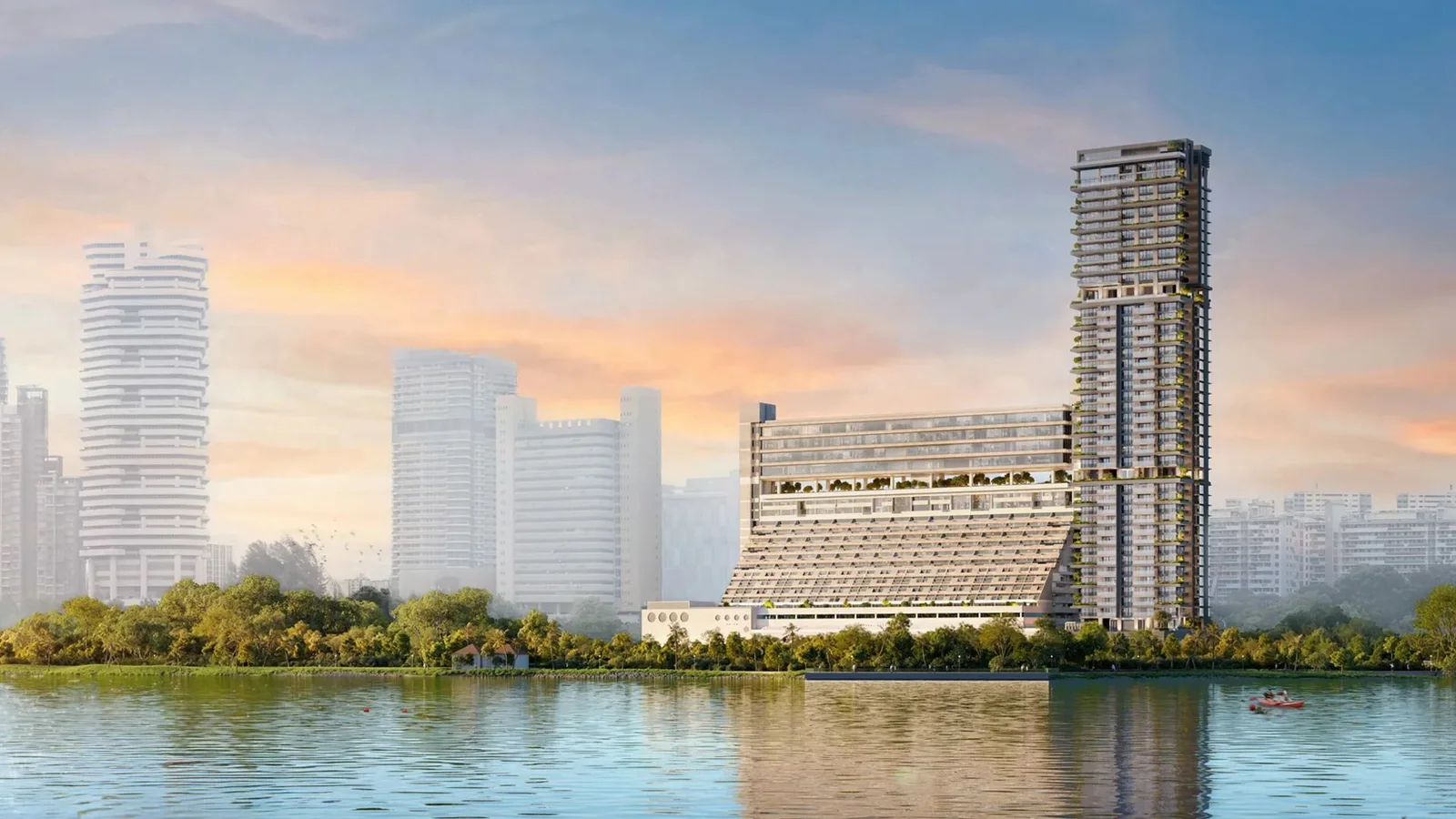
The Serra Residences is 133 units in District 10, from about S$2,560,000, and it sits on a leasehold title of 99 years, not a freehold one. A buyer who had absorbed the association between this developer and long-held freehold land, and carried the assumption into a showflat, would have carried it into the wrong building.
The project is also small, which brings its own consequences that have nothing to do with the developer’s land strategy. At 133 units, the fixed costs of running the estate divide among few households, transaction evidence inside the development will always be sparse, and major replacement items eventually land on a small number of owners. Those are properties of the scale, and they are set out on the project page and, in general form, on the Wing Tai profile.
What the developer’s position does contribute here is the pricing observation from earlier. There is no published land rate against which to test the asking price on a site of this kind, so the whole of the check is the District 10 resale market, recent comparable transactions in the immediate pocket, adjusted honestly for tenure, age and format. The District 10 area guide is the starting point for that.
Scale, and what it is evidence of
More than 700 developments is an unusual number, and it is worth saying precisely what it supports and what it does not.
It supports confidence about completion. A group that has delivered at that volume across private residential, commercial, retail and hospitality has organisational depth, contractor relationships and process that a purchaser paying progressively over four years benefits from.
It does not describe a house style, because 700 developments across 60 years contain many. The hospitality business, hotels the group owns and operates rather than sells, gives it an owner-operator’s view of how buildings perform in daily use, which is a reasonable expectation of care in common areas and not a guarantee of it.
The evidence for how this developer builds is, as ever, the buildings. They are numerous, they are occupied, and they can be visited, which makes this one of the easier developers in Singapore to check, whatever cannot be learned about its land.
For booking mechanics at any launch see the new launch guide, and for an overseas purchaser’s duty position the ABSD guide.
Frequently Asked Questions
Because it already owns land. Founded in 1960 and having delivered more than 700 developments in Singapore, the group accumulated a freehold land bank over decades. A developer holding freehold sites decides when to build on its own schedule rather than bidding against rivals at a state tender and paying whatever the market demands that quarter.
The pricing logic. On a government land sale parcel the award is published, so a buyer can reason from land cost to a plausible price list and see how much room exists. On a site held for decades the historic cost is private, irrelevant to today's decision and unknowable anyway, so the price is set by what the market will pay rather than by what the land cost.
Neither, but it removes a tool. A tendered parcel gives an outside observer a floor under the price and a way to test whether a launch is priced tightly or generously. A long-held site gives no such reference, so the only available test is the local resale market, which is the right test everywhere, and here it is the only one.
Because timing is discretionary. A developer that must recover a tender price on a lease that is already running has a strong incentive to launch quickly. One building on land it has held for years can wait for the market it wants, and can therefore go to market with far less committed in advance than a tender-driven competitor could.
They are separate operating entities within the wider Ng family property network, the Singapore business and the Hong Kong business are run independently. For a Singapore buyer the relevant counterparty is the Singapore entity and, more precisely, the licensed developer named in the sale and purchase agreement.
It gives the group an owner-operator's perspective, since it runs hotels it continues to own rather than selling them on. Whether that reaches a particular residential project is a specification question. As always, the schedule attached to the sale and purchase agreement is where the claim either appears or does not.
Get your Singapore property shortlist
Share your budget and target region. We respond within one business day.