
Allgreen Properties: What 2,203 Units in One Estate Do
Allgreen built Singapore's largest condominium by unit count. At that scale a development stops being a building and becomes its own resale market.
By Invest Singapore Editorial · Updated August 27, 2026 · 8 min read
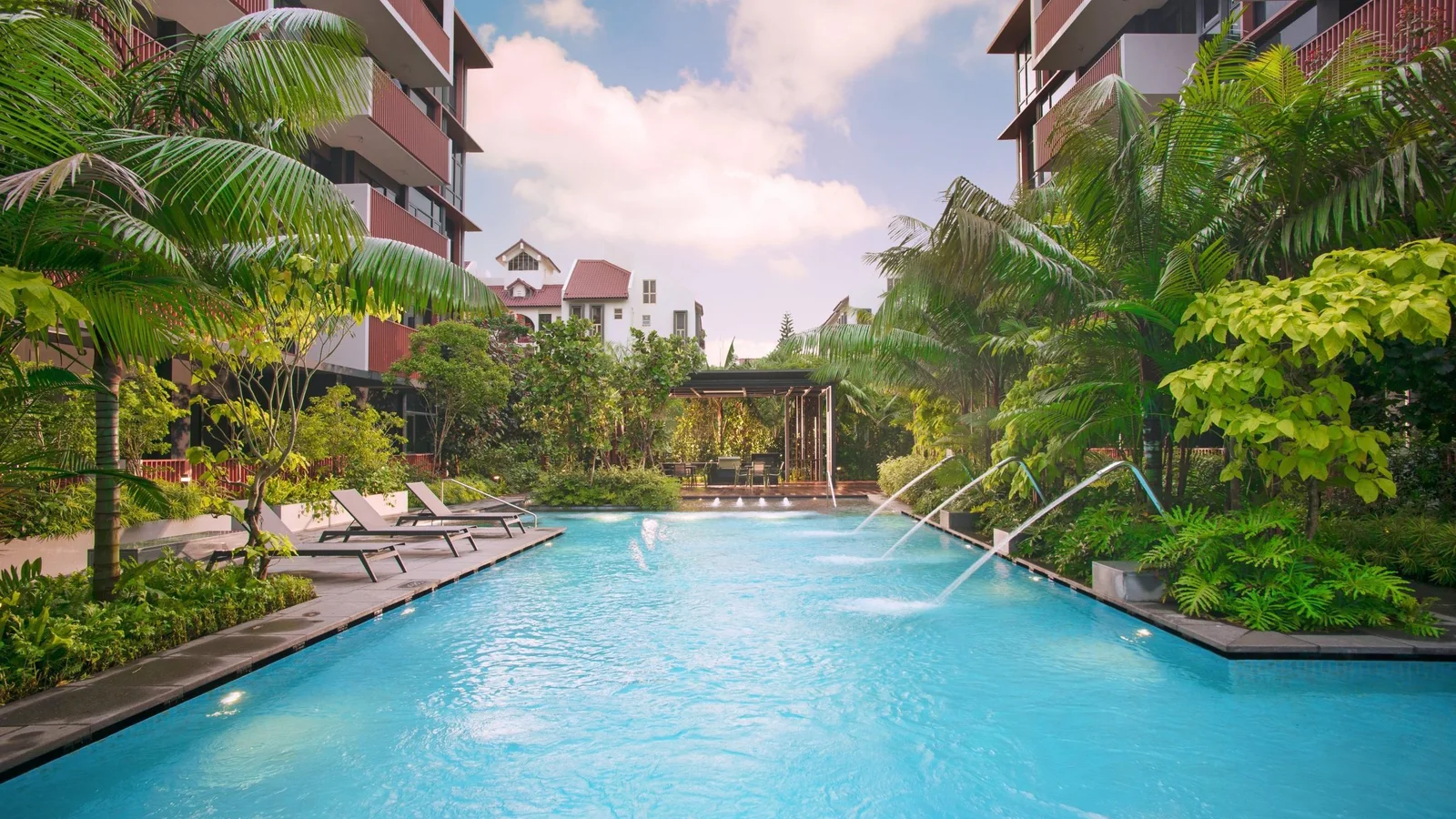
Quick answer: Allgreen Properties is the Kuok Group’s private Singapore development arm, and its defining project is Treasure at Tampines, 2,203 units, the largest private residential development in Singapore by unit count. It has no launch on this site’s 2026 board. What it offers instead is the clearest available answer to a question buyers rarely ask before committing: what changes when a development is large enough to become its own market?
A note on this page’s previous version
An earlier version of this profile described Allgreen as a partner in the Dunearn House joint venture in District 10. That appears to be wrong, and the correction is worth making visibly rather than quietly.
Every other source in this corpus: the Dunearn House project page, the Frasers Property profile and the Sekisui House profile, names the three parties as CSC Land Group, Frasers Property and Sekisui House. Allgreen is not among them. Since a developer profile whose central section describes a project the developer is not building is worse than no profile at all, that section is gone, and this page now describes what the company has actually completed.
What scale does to price discovery
The interesting property of a very large development is statistical, and it is easiest to see by comparison.
| A 300-unit development | Treasure at Tampines, 2,203 units | |
|---|---|---|
| Transactions in a typical year | A handful | Many, across most layouts |
| What a unit is priced against | The district band | Near-identical neighbours |
| Valuation for financing | Comparables from other buildings | Comparables from the same building |
| Effect of one unusual sale | Distorts the record | Absorbed by the rest |
In a small development, a valuer supporting a mortgage reaches outward: other buildings, other vintages, other developers, adjusted by judgement. In a development of this size, they reach inward. The same stack, the same layout, the same facing, transacted recently.
For a buyer that is a real reduction in uncertainty, and it persists for the life of the lease. Nobody at Treasure has to argue about what a two-bedroom on a middle floor is worth; the record answers it.
The price of that certainty
Every advantage here has a matching cost, and it lands on the seller.
A vendor in a 2,203-unit development is one of many with substantially the same thing to sell, and at that size a dozen units of one layout may sit on the market within any 6 months. There is no scarcity argument available, no waiting for the rare buyer who wants exactly this, and no ambiguity about value that a persuasive agent can work with. The market knows the number.
So the clearing price tends to be set by whichever owner most needs to sell that quarter, and everyone else either matches it or waits. In a rising market that is barely noticeable. In a flat or falling one it means the development’s price is anchored by its most motivated participant rather than by its most patient one.
The same applies to letting. A landlord competes with other landlords in the same building, showing prospective tenants the same layouts with different furniture, and rent converges tightly.
What it does to the management corporation
Two effects, pulling in different directions.
On cost, scale helps. The fixed elements of running an estate, management, security, plant maintenance, insurance, administration, are spread across 2,203 households rather than the 300 or 400 of a typical development. That is why very large developments often deliver substantial facilities at proportionately modest monthly contributions, and it is a durable advantage rather than a launch-day one.
On governance, scale complicates. A general meeting with an electorate that size is a different institution from one with 300 owners. Turnout matters, committee elections become organised, and an individual owner’s influence over how the estate is run is small. Decisions get made, large developments are not ungovernable, but they are made through a process rather than through a conversation.
A buyer who cares about how their home is run should read the by-laws and the last set of minutes before purchase, and should understand that at this scale they are joining an institution.
Completion, all at once
There is a third consequence of scale, and unlike the first two it is temporary, which is precisely why it catches people.
A 2,203-unit development does not arrive gradually. It reaches its occupation permit on a date, and within a few months a very large number of households are simultaneously moving in, engaging contractors for renovation, or listing units to let. Investors who bought at launch reach the letting market together, and the first cohort of resellers reaches it together a few years later.
For an owner-occupier that period is an inconvenience: construction noise from neighbours’ fit-outs, lifts full of contractors, common areas under pressure before the estate settles.
For an investor it is the central timing risk of the whole purchase. The first leasing season after handover in a development of this size is the moment of maximum supply and minimum differentiation, and rents set then can take 2 or 3 years to recover to the level the underwriting assumed. The only defenses are a holding plan that does not depend on the first 24 months, and a financing structure that survives a vacancy.
None of this is an argument against large developments: the price discovery and the cost efficiency described above are real and permanent, while this is a phase. It is an argument for underwriting the phase honestly instead of using stabilised assumptions from year five.
The other end of the same portfolio
Allgreen does not only build at that size, and the contrast within one developer is instructive.
The Cascadia, on Bukit Timah Road, is a leasehold condominium in District 10: the school-belt market, where demand is driven by primary school registration catchments and the buyer pool is entirely different from Simei’s. It is a small-format product in an expensive district, and every characteristic described above runs the other way there: thin transaction evidence, scarcity value at resale, a smaller electorate in the management corporation.
The lesson is the one that recurs across these profiles. A developer’s name does not describe a product. The two most prominent things this one has built sit at opposite ends of the market, and a buyer choosing between them is choosing between two entirely different sets of consequences.
One further point about the Kuok Group connection, since it is the fact most often cited about this developer. A well-known conglomerate parent is a reasonable indication of capital depth and of a long horizon, and it is not a guarantee that extends to a purchaser. The contracting party is the licensed developer for the project, and a group’s other businesses are not liable for it. The parent’s name is context; the licence and the sale and purchase agreement are the relationship.
Diligencing a private developer
Allgreen is private. It publishes no accounts, discloses no gearing and reports no pipeline, so the financial diligence available for a listed developer is simply not available here.
The substitute, as with any private developer, is the completed work, and in this case it is abundant and easy to inspect. Both developments named above have stood occupied for years and are open to anyone willing to spend an afternoon looking at common areas, plant and the state of the fabric after 10 or 15 years, and to ask an owner how handover went.
For a buyer wanting to understand what any of this means at a live launch, the boutique version of the same argument is on the Wing Tai profile, and the regional frame for comparing districts is in the CCR, RCR and OCR guide.
Frequently Asked Questions
Scale. Treasure at Tampines, in the Simei part of District 18, delivered 2,203 units on a lease of 99 years and was the largest private residential development in Singapore by unit count. Allgreen is the property development arm of the Kuok Group, incorporated in the early 1990s, and it also builds at the other end of the market: The Cascadia on Bukit Timah Road is a leasehold condominium in the District 10 school belt.
Not on this site's board. That is worth stating rather than manufacturing a pipeline: the developer is active and substantial, and there is no current project here to assess. A profile is more useful describing what the completed work demonstrates than implying availability that does not exist.
It becomes its own market. Enough units transact each year for the development to generate a dense record of its own prices, so a buyer or valuer can price a unit against near-identical neighbours rather than against a district average. It also means every seller competes chiefly with other owners of the same building, and every landlord with other landlords in it.
It is good for price discovery and hard on negotiating position. Nobody buying or selling there is guessing about value, which removes a great deal of the uncertainty that surrounds a boutique development. The cost is that a seller has no scarcity to lean on: there is almost always another unit of the same type available, and the market clears near whatever the most motivated owner accepts.
Fixed costs spread across 2,203 households, which is why very large developments often carry proportionately modest monthly contributions for the facilities provided. The counterpart is governance: general meetings, committee elections and major spending decisions involve a very large electorate, and an individual owner's influence is correspondingly small.
No. It is a private company and publishes nothing, so the ordinary financial diligence available for a listed developer does not exist here. The substitute is the completed work, which in this case is extensive and can be visited.
Get your Singapore property shortlist
Share your budget and target region. We respond within one business day.