
Newport Residences Review 2026: From S$2.38m, 246 Units
Newport is freehold in a 99-year city, guiding S$3,400 psf at Tanjong Pagar. At 2.5-3.5% CCR yields the rent never pays for it, so what does?
By Invest Singapore Editorial · Updated August 27, 2026 · 9 min read
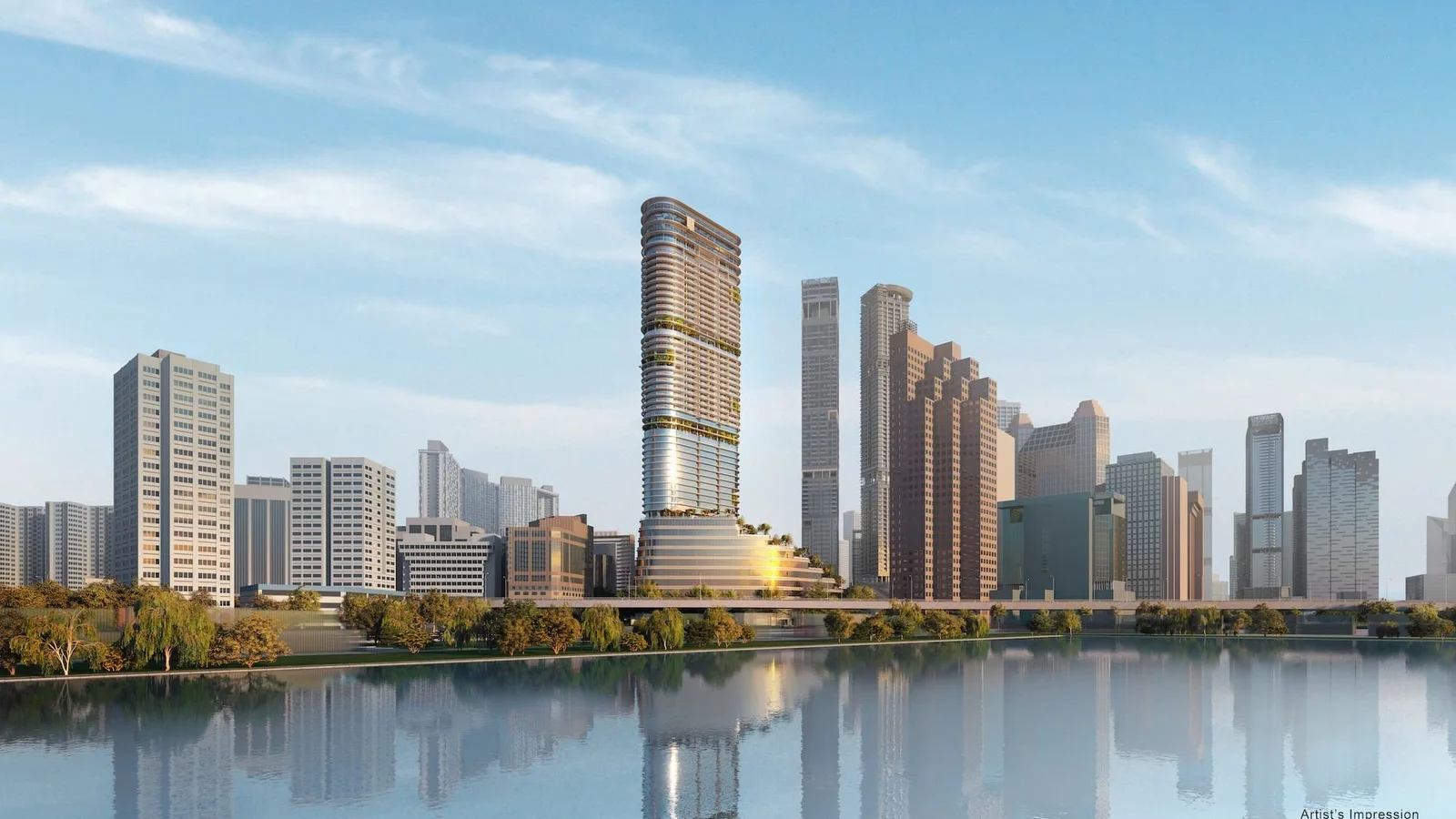
Quick answer: Newport Residences is 246 freehold units by City Developments Limited at Tanjong Pagar, guiding S$3,400 to S$3,800 psf for completion around 2029. Freehold is the entire proposition, and the honest way to test it is to notice that the rent will never pay for it.
What a freehold title is actually worth
A 99-year lease is not a problem for eighty years and then it is the only thing that matters. Financing tightens as the tail shortens, the CPF rules bite, the buyer pool narrows to cash, and a building that was ordinary becomes an en-bloc candidate or a wasting asset. Every leasehold owner in Singapore is on that curve; they simply differ in how far along it they sit.
Freehold removes the curve. That is the whole product. Newport’s premium exists because a buyer at Tanjong Pagar can hold a CBD-fringe address without ever having to think about year 60, year 80 or the collective sale mathematics that follow.
Two things follow from stating it that plainly.
The benefit is real but it is deferred by decades. Nothing about a freehold title improves the next ten years of ownership. The lease on a competing 99-year unit completing in 2029 will still have more than ninety years to run in 2039.
Therefore the buyer and the horizon have to match. Freehold pays for families holding across generations, for estate structures, and for capital parked in Singapore land. It does not pay for a ten-year investor, who is buying a benefit that will not have arrived by the time they sell.
The income case, stated so it can be dismissed
| Line | Figure |
|---|---|
| Indicated entry | S$2,380,000 - S$3,325,000 |
| Guide psf | S$3,400 - S$3,800 |
| CCR gross yields, typical | ~2.5% - 3.5% |
Run the top of that yield band against the bottom of the ticket and the gross rent is a small fraction of the capital committed, before property tax at non-owner-occupier rates, before maintenance on a CBD tower, before vacancy. Net of those, the income does not fund the freehold premium in any period a buyer would recognise.
This is not an argument against the project. It is an argument against justifying it with rent, which is how these purchases are usually sold and how they most often disappoint. If the freehold case is correct, it is correct on land value; the rent is a small offset to the cost of holding.
Where the premium sits against the district
| Reference | psf (S$) |
|---|---|
| Newport Residences launch guide | 3,400 - 3,800 |
| D2 resale, 2025-26 | 2,992 - 3,610 |
| CCR average, 2026 | 2,550 - 3,230 |
The guide clears the top of the D2 resale band. Some of that gap is the ordinary new-build premium that any 2029 completion would command, and some is tenure. Separating them is the one piece of analysis worth paying for here: ask for freehold and leasehold caveats in the same postal district, of similar age and size, and see what the market has actually paid for tenure rather than what the brochure says it is worth.
Who rents a CBD-fringe apartment
Tanjong Pagar’s rental market is unusually legible, because the people who want to live there want the same thing: to stop commuting. The tenant is typically a professional working within walking distance, often on a company allowance, frequently on a posting of two to four years. That produces a market with short leases, high turnover and a strong preference for smaller layouts, because the household is one or two people rather than a family.
Two consequences follow for an owner. Turnover costs are structurally higher than in a family suburb: more frequent agent fees, more frequent void weeks, more frequent make-good. And the demand is cyclical in a specific way, tied to hiring in finance, law and the professional services clustered nearby, so it softens when those employers slow down rather than when the housing market does.
Set against that, the segment prices well when it prices at all, and it is one of the few parts of Singapore where a tenant will pay a real premium purely for minutes saved. A landlord who accepts the turnover and buys the right layout for a single professional is in a defensible business. One who buys a large unit expecting a family tenant at CBD-fringe rents is competing for a household that would generally rather live somewhere else.
What freehold does at the bank
Tenure shows up in financing in a way that is easy to miss at purchase and impossible to miss thirty years later. Lenders price a mortgage against the asset’s remaining life, and a leasehold property’s borrowing capacity contracts as the tail shortens: loan tenure gets capped, valuations turn conservative, and eventually the pool of buyers who can obtain financing at all narrows to those paying cash.
A freehold title never enters that curve. For the buyer at Newport this is not a benefit in 2029, a fresh 99-year lease borrows perfectly well, but it is the mechanism by which the tenure premium is eventually realised. The freehold owner in 2070 is selling to a buyer who can still get an ordinary mortgage; the leasehold owner beside them is not.
That is why the horizon test matters so much on this page. The freehold premium is paid in cash today and collected in liquidity decades later, by whoever holds the asset then. A buyer should be able to name that person, and if the answer is “somebody I will have sold to long before”, the premium is being paid for someone else’s benefit.
The liquidity question
A S$3 million CBD unit has a small buyer pool by construction, and policy makes it smaller. Overseas purchasers are assessed additional buyer’s stamp duty at 60%, which against the S$2,380,000 floor is S$1,428,000 before buyer’s stamp duty: the tiers are in the ABSD guide, and the only escape is the treaty remission order covering five nationalities.
That matters more at exit than at entry. The next buyer faces the same duty, so the resale market for this unit is mostly citizens and permanent residents with S$3 million to place. Freehold widens that pool a little, because it is the feature that survives a long hold. It does not widen it much.
Tenure as a general question is argued in the freehold versus leasehold comparison, and the only other freehold title in this pipeline, a 34-unit mixed-use scheme with commercial co-owners, is Artisan 8. The regional bands are in the CCR, RCR and OCR guide, and the penalty for a short hold in the seller’s stamp duty ladder.
Everything on this page reduces to a question about time. Freehold is a claim on Singapore land that outlives the buyer, priced today and collected by whoever holds it in fifty years. If that person is the buyer’s family, the premium is coherent and the rent is beside the point. If the plan is a sale in the 2030s, the purchase is a leasehold decision being made at a freehold price.
A closing observation about the market this sits in. Freehold CBD-fringe stock changes hands rarely, which means the evidence supporting any valuation is thin in both directions: there is little to argue the price down with, and equally little to argue it up. Buyers who are comfortable in that environment tend to be those holding for reasons other than resale, which is consistent with everything else on this page and worth recognising as a pattern rather than a coincidence.
Frequently Asked Questions
Because almost nothing in Singapore is. Newport is a freehold title on 246 units at Tanjong Pagar, in a city where the private residential market is overwhelmingly 99-year leasehold. The buyer is paying for the one thing a leasehold owner can never acquire later: a title that does not run down.
No, and the arithmetic is not close. CCR gross yields run around 2.5% to 3.5%, so on a ticket of S$2,380,000 to S$3,325,000 the income is a rounding error against the capital. Freehold here is a store-of-value argument about land scarcity, not a cash-flow one, and it should be underwritten as such.
Indicated entry runs from about S$2,380,000 to S$3,325,000 on a guide of S$3,400 to S$3,800 psf, for 246 units by City Developments Limited with completion indicated around 2029.
The guide of S$3,400 to S$3,800 psf sits above a D2 resale band of S$2,992 to S$3,610 and well above the CCR average of S$2,550 to S$3,230. Part of that gap is new-build premium and part is tenure; separating the two is the central pricing question for a buyer here.
Buyers whose horizon is longer than their own ownership: family holding structures, estate planning, and capital looking for a Singapore store of value rather than a yield. A buyer who intends to sell within a decade is paying for a lease profile that will barely have moved by the time they exit.
A thinner buyer pool. Higher absolute tickets in the Central Region shrink the number of buyers who can transact at all, and foreign buyers face 60% ABSD on top, which removes much of the international demand that would otherwise support a CBD address. Liquidity, not price, is the variable to stress-test.
Get your Singapore property shortlist
Share your budget and target region. We respond within one business day.