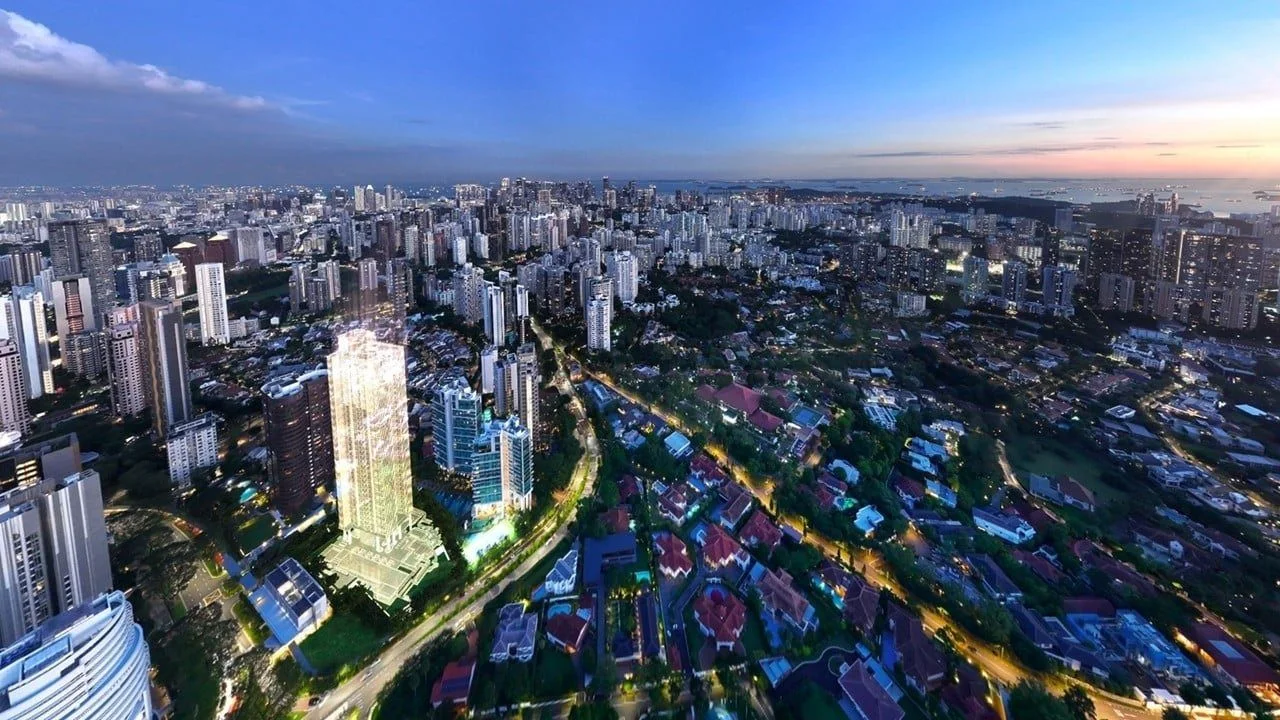
CCR vs RCR Property Investment Singapore Compare 2026
CCR vs RCR Singapore: S$3,208 vs S$2,695 psf, 2.5–3.5% vs 3.0–4.0% gross yield, Q1 2026 +0.6% vs +0.8% q/q, tenant profiles, ABSD maths.
By Invest Singapore Editorial · Updated June 17, 2026 · 24 min read
Quick answer: CCR averages S$3,208 psf versus RCR at S$2,695 psf in 2026 estimates. CCR gross yield runs 2.5–3.5%; RCR runs 3.0–4.0% where older stock and broader tenant pools support wider income spreads. Q1 2026 URA data shows CCR up 0.6% quarter-on-quarter and RCR up 0.8% q/q. Foreign buyers face 60% ABSD in both regions, which dominates the investment case at either PSF level.
Invest Singapore 2026 regional framework
Singapore’s residential market sorts into three concentric zones under URA’s planning framework. Core Central Region occupies the prime inner ring: Districts 9, 10, and 11 plus Sentosa Cove and the Downtown Core. Rest of Central Region forms the next ring: Districts 1, 2, 3, 4, 5, 6, 7, 8, 12, 13, 14, 15, 20, and 21. Outside Central Region covers the heartland beyond that perimeter.
Investors shortlist CCR and RCR when they want central exposure without committing to heartland OCR logistics. The two regions differ sharply on price, yield profile, tenant character, and the type of capital event that drives returns. Understanding those differences before engaging an agent saves significant time and money.
This comparison builds on our CCR vs RCR vs OCR Singapore property guide, which maps all three zones against each other. Here we go one level deeper: the precise PSF delta between CCR and RCR, what that translates to on a worked investment, and which buyer profile each region actually serves in 2026. District-level detail for key CCR addresses appears in the District 9 Orchard property hub and District 10 Bukit Timah property hub. For RCR examples, see District 3 Queenstown property and District 15 East Coast property. Yield line items by region appear in the Singapore rental yield guide.
CCR at a glance
Core Central Region is Singapore’s prestige address band. District 9 covers Orchard Road and River Valley: the city’s luxury retail and hospitality spine, with ground-floor branded residences, service apartments, and freehold condominiums priced for globally mobile high-net-worth buyers. District 10 covers Bukit Timah, Holland Road, and Tanglin: landed and condominium stock on elevated terrain, historically the domain of expatriate families on diplomatic and regional headquarters contracts. District 11 adds the Novena and Newton corridor, bridging medical-professional tenancy and proximity to Orchard without the highest Orchard PSF.
Sentosa Cove within CCR operates under foreign ownership rules that allow foreigners to hold landed property, a unique carve-out in Singapore’s residential framework. That exception attracts a subset of global buyers but the submarket is thin and cyclical.
CCR stock ranges from pre-2000 freehold blocks in good locations through to post-2010 integrated developments with direct MRT connectivity. New launches in CCR are infrequent; land is scarce and developers price launches to reflect the address premium, often well above S$3,000 psf on freehold sites. Resale CCR condos in established districts can still be found in the S$2,800–S$3,600 psf band depending on age, tenure, and renovation state.
| Factor | CCR snapshot |
|---|---|
| URA region | Core Central Region |
| 2026 PSF estimate | S$3,208 average |
| Key districts | D9 Orchard, D10 Bukit Timah, D11 Novena |
| Primary buyer | HNWI, global expats, freehold wealth store |
| Primary tenant | C-suite, diplomatic, regional HQ executives |
| Indicative gross yield | 2.5–3.5% |
| Q1 2026 price change | +0.6% q/q |
| Entry ticket (750 sq ft) | Approx S$2.41M before stamp duty |
RCR at a glance
Rest of Central Region covers a broader and more varied geography. It includes inner-city districts like River Valley fringe and Tanjong Pagar at the CBD edge, established residential areas like Queenstown (D3) and Bishan (D20), lifestyle coastal zones like East Coast (D15), and mature heartland fringe areas like Geylang (D14) and Tiong Bahru (D3).
That diversity is RCR’s strength from an investment perspective. Rather than a single premium address narrative, RCR offers micro-location stories: CBD commute savings in Queenstown, coastal family demand in East Coast, food and heritage character in Tiong Bahru, school-belt demand in Bishan. Investors who understand the district they are buying often outperform the regional average because they pick the right sub-story at the right price.
RCR PSF sits at a 16% discount to CCR on 2026 estimates. That discount is not uniform across all RCR districts. A Tanjong Pagar CBD-edge unit might trade at S$2,900–S$3,100 psf, blurring into the CCR band. A Geylang rental block may trade at S$2,200–S$2,500 psf, sitting well below the S$2,695 regional average. The average is a starting point, not a guarantee.
| Factor | RCR snapshot |
|---|---|
| URA region | Rest of Central Region |
| 2026 PSF estimate | S$2,695 average |
| Key districts | D3 Queenstown, D15 East Coast, D20 Bishan, D12/D13 Balestier, D14 Tanjong Pagar fringe |
| Primary buyer | Upgraders, investors, CBD commuters, families |
| Primary tenant | Professionals, medical, tech, expat families |
| Indicative gross yield | 3.0–4.0% |
| Q1 2026 price change | +0.8% q/q |
| Entry ticket (750 sq ft) | Approx S$2.02M before stamp duty |
PSF benchmarks: S$3,208 versus S$2,695
The S$513 psf gap between CCR and RCR is one of the most cited metrics in Singapore property analysis. On a 750 sq ft unit it translates to S$384,750 in additional purchase price. On a 900 sq ft unit it becomes S$461,700. On a 1,200 sq ft family unit it exceeds S$615,000.
| Unit size | CCR at S$3,208 psf | RCR at S$2,695 psf | Premium paid for CCR |
|---|---|---|---|
| 500 sq ft | S$1,604,000 | S$1,347,500 | S$256,500 |
| 750 sq ft | S$2,406,000 | S$2,021,250 | S$384,750 |
| 900 sq ft | S$2,887,200 | S$2,425,500 | S$461,700 |
| 1,200 sq ft | S$3,849,600 | S$3,234,000 | S$615,600 |
The premium must be justified by one or more of three things: higher rental income that narrows the yield gap, stronger capital appreciation, or utility value for an owner-occupier who genuinely places a premium on the address.
CCR does not automatically produce higher rental income in psf terms when compared to RCR. Prime Orchard one-bedrooms may attract rents of S$7,000–S$10,000 monthly, which at 600 sq ft gives S$11.67–S$16.67 psf. But many CCR units are larger-format family apartments in the 1,200–2,000 sq ft range, where monthly rents of S$12,000–S$20,000 translate to S$6–S$10 psf. RCR professional units at S$5.13–S$5.50 psf in compact 700–900 sq ft formats can close the effective income gap faster than the headline PSF delta suggests.
Before comparing regions, run the calculation on the specific building, floor plate, and tenant profile you are underwriting, not on regional PSF averages alone.
Gross yield: 2.5–3.5% vs 3.0–4.0%
The yield advantage for RCR over CCR is structural at 2026 pricing. Higher purchase PSF without proportionally higher rental PSF mathematically compresses CCR gross yield.
CCR yield example at 2.5% and 3.5%
| Unit size | CCR price (S$3,208 psf) | Annual rent at 2.5% | Annual rent at 3.5% |
|---|---|---|---|
| 750 sq ft | S$2,406,000 | S$60,150 (S$5,013/mo) | S$84,210 (S$7,018/mo) |
| 900 sq ft | S$2,887,200 | S$72,180 (S$6,015/mo) | S$101,052 (S$8,421/mo) |
The 2.5% floor represents a unit with modest rent recovery relative to its CCR ticket price. The 3.5% ceiling represents a compact, well-located unit in a strong rental pocket like River Valley or Novena where rent psf approaches S$8–S$9.
RCR yield example at 3.0% and 4.0%
| Unit size | RCR price (S$2,695 psf) | Annual rent at 3.0% | Annual rent at 4.0% |
|---|---|---|---|
| 750 sq ft | S$2,021,250 | S$60,638 (S$5,053/mo) | S$80,850 (S$6,738/mo) |
| 900 sq ft | S$2,425,500 | S$72,765 (S$6,064/mo) | S$97,020 (S$8,085/mo) |
The 3.0% floor represents older RCR leasehold stock at standard rent per square foot. The 4.0% ceiling represents compact units in strong demand nodes, older-building pricing well below the regional PSF average, or units where recent renovation lifts rent above regional median.
Net yield reality
Gross yield does not account for holding costs. Subtract the following before comparing returns:
| Annual cost item | Typical range |
|---|---|
| Management fund (maintenance) | S$4,800–S$9,600 (older CCR stock can exceed this) |
| Property tax on non-owner-occupied | 11–20% of annual value |
| Agent renewal fee (annualised) | S$2,000–S$3,500 |
| Vacancy haircut 5–8% | Based on annual gross rent |
| Occasional capex and repairs | S$3,000–S$10,000 per year |
On a S$2.4M CCR unit at 3% gross yield, net operating income after those deductions commonly falls into the 1.2–1.8% net yield range. On a S$2.0M RCR unit at 3.5% gross yield, net yield typically runs 1.8–2.4%. The RCR income advantage survives into net territory, though neither region produces a strong cash-flow case at current PSF levels. The Singapore rental yield guide provides a full net yield model with input variables you can adjust.
Q1 2026 price momentum: +0.6% vs +0.8%
URA private residential price indices for Q1 2026 recorded Core Central Region growth of 0.6% quarter-on-quarter. Rest of Central Region grew 0.8% q/q. Outside Central Region led at 2.2% q/q, driven by new launch activity in suburban growth corridors.
On an annualised basis, a sustained 0.6% q/q CCR rate implies roughly 2.4% annual price appreciation. Sustained 0.8% q/q in RCR implies roughly 3.2% annual appreciation. Neither rate justifies buying on capital gain assumptions alone at 2026 PSF entry levels, particularly when ABSD, legal fees, and renovation capex load the cost base.
The Q1 2026 data supports a broader pattern since late 2023: RCR has outperformed CCR on percentage price movement while CCR has maintained its absolute PSF premium. That combination means RCR buyers captured more percentage gain on a lower cost base, while CCR buyers held value in absolute dollar terms.
Seasonal patterns matter too. Q1 typically reflects year-end transaction settlements and Chinese New Year demand. Single-quarter data should be read alongside the URA’s rolling four-quarter trend before drawing forward projections.
| Region | Q1 2026 q/q change | Annualised if sustained | 2026 average PSF est. |
|---|---|---|---|
| CCR | +0.6% | ~2.4% | S$3,208 |
| RCR | +0.8% | ~3.2% | S$2,695 |
| OCR | +2.2% | ~9.0%+ | S$2,100 est. |
OCR’s 2.2% q/q is an outlier driven by specific new launches; it should not be projected linearly. CCR and RCR movements reflect genuine resale and new-sale transact patterns across wider district sets.
Tenant profiles: who rents in CCR versus RCR
Tenant quality and depth determine how quickly you backfill a vacant unit and at what rent. The two regions attract structurally different tenant populations.
CCR tenant profile
CCR commands its PSF premium partly because it attracts tenants who pay for address. That tenant group includes:
Regional headquarters executives on corporate housing packages who require Orchard or Bukit Timah addresses for business card and lifestyle reasons. These tenants often sign two-year leases at S$8,000–S$18,000 monthly and expect premium finishes, 24-hour concierge, and pool and gym facilities in good order.
Diplomatic tenants on government housing allowances who are restricted to certain CCR districts by their posting terms. Demand from this group has contracted since the post-2020 cost rationalisation of corporate relocations, but it persists for well-located freehold stock in District 10.
Financial sector professionals at senior levels who choose to live near the CBD at Shenton Way or at the Orchard-River Valley nexus and commute on foot or by taxi. This group is interest-rate and bonus cycle sensitive; a weak banking year shows up in CCR vacancy.
High-net-worth owner-occupiers who rent a secondary property rather than buy, particularly families with children at international schools near Bukit Timah. They are stable tenants but thin in number.
The collective result: CCR achieves higher absolute monthly rents, but the tenant pool is shallower and more sensitive to corporate and financial sector sentiment than RCR.
RCR tenant profile
RCR’s wider geography supports a broader tenant mix:
CBD-commuting professionals in Queenstown, Tanjong Pagar fringe, and Tiong Bahru who prioritise MRT travel time over address prestige. This group fills one- and two-bedroom units reliably through economic cycles.
Medical and healthcare professionals working at Singapore General Hospital, NUH, and the Novena medical cluster. These tenants are stable, income-secure, and often renew leases for multi-year periods.
Technology and research tenants at the one-north business park cluster, including Biopolis and Fusionopolis, who choose Queenstown or Buona Vista fringe addresses.
Expatriate families on mid-tier corporate packages who want central access without CCR pricing. They fill three-bedroom units in East Coast, Bishan, and Queenstown near international schools on two- to three-year contracts.
Local upgraders renting while waiting to accumulate for a purchase. Singapore’s HDB upgrader pool feeds RCR demand reliably, providing a floor under vacancy rates that CCR lacks.
The collective result: RCR achieves lower absolute monthly rents per unit, but tenant depth is wider, void periods are typically shorter, and revenue recovers faster after a lease expiry.
Stock age, tenure, and renovation
Both CCR and RCR carry significant legacy stock. The implications differ by region and unit type.
CCR stock reality
Orchard-area condominiums from the 1970s and 1980s include some of Singapore’s most recognisable addresses, but interior standards vary widely. A Scotts Road address in a 1983 block may trade at CCR PSF while requiring S$120,000–S$200,000 in renovation to match the finishes expected by C-suite tenants. Newer CCR integrated developments from 2010 onward typically require less capex but command the highest PSF.
Freehold tenure is more common in CCR than in other regions. That freehold premium is real over a 30-year hold but invisible over a five-year hold period after stamp duty costs. Buyers who pay a 15–20% premium for freehold over adjacent 99-year leasehold should underwrite the hold period honestly before booking.
RCR stock reality
RCR includes Queenstown estates from the late 1970s and East Coast condos from the 1980s alongside post-2000 developments near new MRT stations. Older RCR stock can require S$50,000–S$120,000 renovation for family-grade presentation, less for professional-target compact units.
Leasehold dominates new and resale RCR transactions. Remaining lease affects financing: banks typically limit loan tenure to 30 years or remaining lease minus 30 years, whichever is shorter. A 60-year remaining lease unit may qualify for only a 30-year loan, not 35. Check CPF withdrawal rules and bank valuation before committing.
En-bloc activity in RCR periodically creates capital events. Queenstown, Tanjong Pagar, and selected East Coast blocks have been recipients of collective sale bids that deliver premiums of 20–40% above market value for individual owners. No en-bloc is guaranteed, but the pipeline is active in RCR in ways it rarely is in CCR where site values are already maximised.
Foreign buyer ABSD maths: the 60% reality
Foreign buyers face 60% Additional Buyer’s Stamp Duty on residential purchases in Singapore as of the June 2023 cooling measure, which remains in force through 2026. That charge applies on top of standard Buyer’s Stamp Duty and is calculated on purchase price or market value, whichever is higher.
All-in cost on CCR at S$3,208 psf
| Unit size | Price | BSD est. | ABSD at 60% | Legal + misc | All-in |
|---|---|---|---|---|---|
| 750 sq ft | S$2,406,000 | S$73,520 | S$1,443,600 | S$15,000 | approx S$3,938,120 |
| 900 sq ft | S$2,887,200 | S$93,616 | S$1,732,320 | S$15,000 | approx S$4,728,136 |
All-in cost on RCR at S$2,695 psf
| Unit size | Price | BSD est. | ABSD at 60% | Legal + misc | All-in |
|---|---|---|---|---|---|
| 750 sq ft | S$2,021,250 | S$59,725 | S$1,212,750 | S$15,000 | approx S$3,308,725 |
| 900 sq ft | S$2,425,500 | S$73,365 | S$1,455,300 | S$15,000 | approx S$3,969,165 |
At 60% ABSD, gross yield must be calculated on the all-in cost to be meaningful. A 3.0% gross yield on S$2,021,250 RCR purchase price becomes a 1.8% effective yield on S$3.3M all-in cost. The economics require either very strong rent growth, a long hold period that amortises the stamp duty burden, or FTA exemption to make the numbers work.
US and Swiss national buyers qualify for 0% ABSD on a first residential purchase under their respective Free Trade Agreements with Singapore. Buyers who hold citizenship of either country should confirm FTA eligibility with a qualified legal advisor before engaging agents. That single status change rewrites the entire investment model at both CCR and RCR price levels.
Permanent Residents face lower ABSD tiers (5% on first purchase, 30% on second). PR buyers dominate many RCR transactions because the lower stamp duty burden makes RCR pricing viable for wealth-storage with some yield.
Pros and cons side by side
| Dimension | CCR | RCR |
|---|---|---|
| Entry PSF | S$3,208 (higher) | S$2,695 (lower) |
| Gross yield range | 2.5–3.5% | 3.0–4.0% |
| Q1 2026 q/q growth | +0.6% | +0.8% |
| Tenant depth | Thin, high-end | Wide, multi-profile |
| Absolute monthly rent | Higher | Moderate |
| Void risk | Higher in downturns | Lower; broader pool |
| Stock type | Freehold common; luxury condos | Leasehold dominant; varied ages |
| En-bloc potential | Low (maximised sites) | Active pipeline in select districts |
| Owner-occupier lifestyle | Premium central address | Family, commute, lifestyle mix |
| ABSD all-in burden | Higher (higher base price) | Lower (lower base price) |
| Foreign buyer access | Sentosa Cove landed; standard condo | Standard condo same rules |
CCR advantages
Address scarcity is the primary CCR argument. Orchard Road, Bukit Timah, and River Valley are not replicable by rezoning. The land bank is finite. For buyers who plan to hold for 15 or more years and who can place a premium on liquidity to other high-net-worth buyers globally, CCR freehold stock has served as a stable store of value through Singapore’s multiple economic cycles since the 1990s.
Premium tenants on corporate packages can achieve rents that close the yield gap more than the regional average suggests. A 1,200 sq ft Orchard freehold unit leased at S$18,000 monthly to a financial sector MD on a two-year lease implies a meaningful yield on the specific investment.
CCR enjoys the deepest pool of global buyers on exit. When you sell in 10 years, CCR addresses attract Hong Kong, Indonesian, and European buyers alongside local HNWIs. That demand breadth supports resale liquidity even in Singapore’s cooling-measure environment.
CCR disadvantages
60% ABSD makes CCR inaccessible for most foreign buyers without FTA relief. The all-in cost on a standard 900 sq ft CCR unit approaches S$4.7M, beyond the threshold where rental yield alone justifies the capital at risk.
Corporate housing budgets have rationalised post-2020. Companies that once paid S$15,000 monthly for Orchard expat housing now negotiate S$10,000–S$12,000 budgets or choose serviced apartments for short-cycle assignments. That demand compression hurts CCR landlords more than RCR landlords.
New supply risk from integrated development launches can create temporary oversupply pockets. CCR land sales at record PSF translate to launches at S$3,500–S$4,000 psf that require years of absorption.
RCR advantages
Higher income yield relative to purchase price is the primary RCR argument. At S$2,695 psf, the entry ticket is 16% below CCR. A 3.0–4.0% gross yield on a lower base produces similar absolute rental income to some CCR units at lower capital risk.
Broader tenant depth reduces void risk through economic cycles. Professional, medical, and tech anchors in districts like Queenstown and Bishan provide rental demand that does not disappear when a single corporation rationalises its housing budget.
Greater Southern Waterfront, the Jurong Lake District, and MRT network expansion under the Circle Line and Thomson-East Coast Line extensions create infrastructure-driven capital events in specific RCR sub-markets that are not available in already-maximised CCR districts.
RCR disadvantages
Leasehold dominates RCR stock. Depreciation risk on older leasehold units accelerates when remaining lease falls below 70 years and CPF usage becomes restricted. Buyers who choose 40-year remaining leasehold units at apparent discounts must model exit in a market where buyer financing is constrained.
RCR micro-location variation is larger than CCR. A S$2,695 psf RCR average masks a wide range from sub-S$2,200 psf in specific Geylang pockets to S$3,100 psf at CBD-edge Tanjong Pagar premium projects. Buyers who do not understand their specific district can overpay for a mid-RCR address at a CCR-adjacent price.
Buyer scenarios: who should pick which region
Scenario 1: Global HNWI seeking Singapore as second-home base
CCR is the natural choice if the buyer holds US or Swiss citizenship, qualifies for 0% ABSD, and wants an address that is recognisable internationally for business and social purposes. Orchard freehold or a District 10 Bukit Timah family home serves both habitation and wealth-storage functions. Underwrite on a 15-year hold with conservative 2% annual rent growth.
If the buyer holds a non-FTA passport, the 60% ABSD makes CCR viable only with very long hold periods or significant rent premium over RCR. Consider Sentosa Cove for landed property access with its own specific market dynamics.
Scenario 2: Singapore PR seeking first investment property
RCR typically outperforms CCR for PRs on a first investment purchase. At 5% ABSD on first purchase, RCR entry at S$2.0M plus S$100,000 ABSD produces a manageable all-in cost. Gross yield in RCR of 3.0–4.0% against a S$2.1M effective cost base gives a workable income stream. Queenstown and East Coast deliver strong tenant depth for PRs who understand the micro-location.
CCR at a first-purchase cost of S$2.4M plus 5% ABSD is viable at S$2.52M all-in if rental recovery supports 3.5% gross. The challenge is finding CCR units that actually achieve 3.5% at 2026 PSF in broadly available stock, not just the top-decile performers.
Scenario 3: Yield-focused investor at any nationality
RCR wins on yield metrics for almost all nationality profiles. The 0.5–1.0 percentage point gross yield advantage at equivalent unit sizes, combined with wider tenant depth and lower absolute ABSD burden, produces better net income outcomes than CCR in the 2026 pricing environment.
Target Queenstown, East Coast, and Bishan districts where tenant demand is structural, not aspirational. Avoid districts where RCR labelling masks thin rental markets. Use the Singapore rental yield guide to model net yield with realistic vacancy and maintenance inputs before committing.
Scenario 4: Family owner-occupier relocating to Singapore
Owner-occupiers can justify CCR on lifestyle grounds if schooling near international campuses in Bukit Timah or Tanglin is the priority and the employment package covers housing costs. For families who will also generate rental income when they eventually exit Singapore, CCR’s resale depth to other international buyers supports exit liquidity.
RCR serves families who want quality central living without Orchard-grade pricing. East Coast school corridors, Bishan-Ang Mo Kio Park access, and Queenstown MRT efficiency each offer genuine lifestyle value that many families rank alongside address prestige.
Scenario 5: Investor targeting en-bloc capital event
RCR outperforms CCR for en-bloc optionality. Specific Queenstown blocks, East Coast ageing condos, and Tanjong Pagar fringe buildings have entered and completed collective sales in recent cycles. The premium over market value in successful en-bloc transactions has ranged from 20% to over 50% for owners who hold at the right point in the urban renewal cycle.
CCR does not offer the same en-bloc pipeline. Sites are maximised; developer economics do not work when land values are already at CCR-grade psf. The CCR capital event story runs through redevelopment of individual large freehold blocks, not collective sales.
Scenario 6: Corporate investor managing a Singapore property portfolio
Large portfolios typically hold both CCR and RCR for diversification. CCR properties provide address-anchor stability and access to global HNW buyers on exit. RCR properties provide income yield and tenant diversity. The ratio depends on total portfolio size, ABSD tier, and income requirements. For institutional-level buyers who have exhausted ABSD-favourable structures, the yield advantage of RCR often pushes allocation toward central fringe at scale.
Decision matrix
| Your priority | Lean CCR | Lean RCR |
|---|---|---|
| Premium address scarcity | Yes | |
| Higher gross income yield | Yes | |
| Wider tenant pool | Yes | |
| Freehold tenure prevalence | Yes | Partial |
| Lower all-in ABSD cost | Yes | |
| En-bloc capital event optionality | Yes | |
| Corporate housing tenancy | Yes | Partial |
| Family professional tenant demand | Partial | Yes |
| Sentosa Cove landed access | Yes | |
| Q1 2026 price momentum | Yes | |
| Long-hold wealth store | Yes | |
| Yield-driven income portfolio | Yes |
When priorities tie on multiple rows, run two underwriting spreadsheets using the same unit size, same hold period, same financing assumptions, and realistic net rent. The region that produces higher net present value after ABSD amortisation and vacancy wins, not the one with the more recognisable district name.
Worked example: 750 sq ft two-bedroom comparison
Assume 750 sq ft two-bedroom unit, 10-year hold, median rent assumptions, S$600 monthly maintenance, and 6% vacancy on CCR versus 5% vacancy on RCR to reflect tenant depth differences.
| Line item | CCR (S$3,208 psf) | RCR (S$2,695 psf) |
|---|---|---|
| Purchase price | S$2,406,000 | S$2,021,250 |
| BSD (indicative) | S$73,520 | S$59,725 |
| ABSD at 60% (foreign) | S$1,443,600 | S$1,212,750 |
| All-in cost (foreign) | S$3,938,120 | S$3,308,725 |
| Monthly rent (gross) | S$6,015 (3.0%) | S$5,053 (3.0%) |
| Annual gross rent | S$72,180 | S$60,636 |
| Vacancy haircut (6% / 5%) | S$4,331 | S$3,032 |
| Maintenance annual | S$7,200 | S$7,200 |
| Property tax (indicative) | S$9,500 | S$7,800 |
| Agent renewal (annualised) | S$2,800 | S$2,300 |
| Net operating income | S$48,349 | S$40,304 |
| Gross yield on price | 3.00% | 3.00% |
| Net yield on price | ~2.01% | ~2.00% |
| Net yield on all-in (foreign) | ~1.23% | ~1.22% |
At equivalent gross yield assumptions, the net return on all-in cost for foreign buyers converges because the ABSD burden scales with price. The CCR buyer has deployed more capital for similar percentage return. The CCR argument then rests entirely on capital appreciation differential over the hold period, not income yield.
Adjust the rent psf upward for a premium CCR unit achieving 3.5% gross: net yield on price improves to roughly 2.5%, and net yield on all-in approaches 1.5% for a foreign buyer. That is still a weak income case but a less extreme one. Capital appreciation plus rental covering carrying cost becomes the combined thesis, not yield alone.
What to verify before you choose
Pull URA REALIS transaction records for the specific building and comparable buildings within 500 metres. Look at the last eight quarters of transacted PSF. Median is more reliable than one-off headline prices.
Request URA rental submission data for the same building or postal district over the last four quarters. Brochure rent claims from agents may lag actual market conditions. The gap between marketed rent and transacted rent in CCR can be significant in slow quarters.
Inspect management corporation strata title financials. Older CCR buildings with deferred maintenance sometimes carry sinking fund deficits that will translate into special levies on owners. RCR buildings from the 1970s and 1980s increasingly face lift replacement and facade works that are not always fully funded.
Confirm lease remaining and financing implications. Bring your intended loan amount and remaining lease into a bank pre-approval conversation before signing any option. Do not assume the bank’s valuation will match the transacted price.
Walk the property at a weekday morning and evening. CCR blocks on busy Orchard-adjacent roads can have noise issues that do not appear in a Saturday afternoon viewing. RCR blocks far from MRT can have commute times that are longer than Google Maps suggests during peak hour.
Cross-reference district hubs for micro-location detail: District 9 Orchard property for prime CCR, District 10 Bukit Timah property for family CCR, District 3 Queenstown property and District 15 East Coast property for representative RCR addresses.
Closing comparison
CCR and RCR represent different investment theses, not a simple cheap-versus-premium ranking. CCR buys address scarcity, freehold prevalence, and access to global HNW buyers on exit. RCR buys higher income yield, wider tenant depth, and optionality on urban renewal capital events.
At 2026 benchmark figures, S$3,208 psf for CCR and S$2,695 psf for RCR, the income yield advantage sits firmly with RCR at 3.0–4.0% versus 2.5–3.5% for CCR. Q1 2026 price momentum also marginally favoured RCR at +0.8% q/q versus +0.6% for CCR. The CCR counterargument is long-hold store of value, premium tenancy ceiling, and resale liquidity to internationally mobile buyers that RCR districts cannot always replicate.
Foreign buyers at 60% ABSD face all-in costs that make the income yield case secondary in both regions. The primary question for that cohort becomes: which region’s capital appreciation history and tenant pool justify the stamp duty burden over a ten-year or longer hold? For most foreign buyers without FTA relief, that answer requires conservative assumptions, patient capital, and clear personal utility in addition to investment return.
For PRs, local investors, and FTA-eligible foreign buyers, the region choice narrows to risk preference, tenant profile alignment, and specific building selection within each zone. Run the numbers, verify the building, and buy the investment that survives your worst-case rental assumption, not the brochure best case.
Frequently Asked Questions
Core Central Region averages around S$3,208 psf in 2026 estimates, while Rest of Central Region averages around S$2,695 psf. The S$513 psf gap on a 900 sq ft unit translates to roughly S$461,700 in additional purchase price before stamp duty. That premium reflects Orchard, Bukit Timah, and River Valley address scarcity, not a proportional advantage in rental income or guaranteed capital appreciation.
RCR typically produces higher gross yield than CCR at 2026 PSF levels. Indicative CCR gross yield runs 2.5–3.5% on prime district pricing; RCR runs 3.0–4.0% where older leasehold stock and stronger rental demand relative to purchase price support wider income spreads. Net yield in both cases narrows significantly after maintenance, property tax, vacancy, and agent fees.
URA private residential price data for Q1 2026 shows Core Central Region up 0.6% quarter-on-quarter and Rest of Central Region up 0.8% quarter-on-quarter. OCR led overall momentum at 2.2% q/q. The data reflects selective demand in central districts rather than broad appreciation, with RCR marginally outperforming CCR on percentage price gain in that quarter.
Foreign buyers face 60% Additional Buyer's Stamp Duty on residential purchases, which applies equally to CCR and RCR properties. On CCR at S$3,208 psf, a 750 sq ft unit at roughly S$2.4M becomes over S$3.8M all-in after ABSD and BSD. On RCR at S$2,695 psf, the same size unit at S$2.0M becomes around S$3.2M all-in. US and Swiss FTA-eligible buyers at 0% ABSD on a first property can compare both on gross yield without the same drag. FTA status changes the entire investment calculus.
CCR attracts C-suite executives, financial sector professionals, and diplomatic-rate tenants who pay premium rents for Orchard, Bukit Timah, or River Valley addresses. RCR attracts a broader mix: CBD-commuting professionals, medical cluster workers, tech employees at one-north, and family tenants near East Coast Park or Queenstown. RCR tenant depth is wider, supporting faster backfill on vacancy. CCR commands higher absolute monthly rent but serves a thinner, more cyclical high-end market.
CCR's land scarcity in prime districts like Orchard and Bukit Timah supports a store-of-value thesis over long hold periods, particularly on freehold or long-leasehold titles. RCR benefits from urban renewal pipelines including Greater Southern Waterfront, selective en-bloc activity, and MRT network expansion that can drive localised capital events. Neither region guarantees appreciation; both respond to macroeconomic conditions, policy cooling measures, and supply cycles. Hold period, financing cost, and renovation capex matter more than region label on a ten-year underwrite.
Get a Singapore property shortlist
Share your budget, target region (CCR, RCR, or OCR), and FTA status. We reply within one business day with matched new launch and resale options.